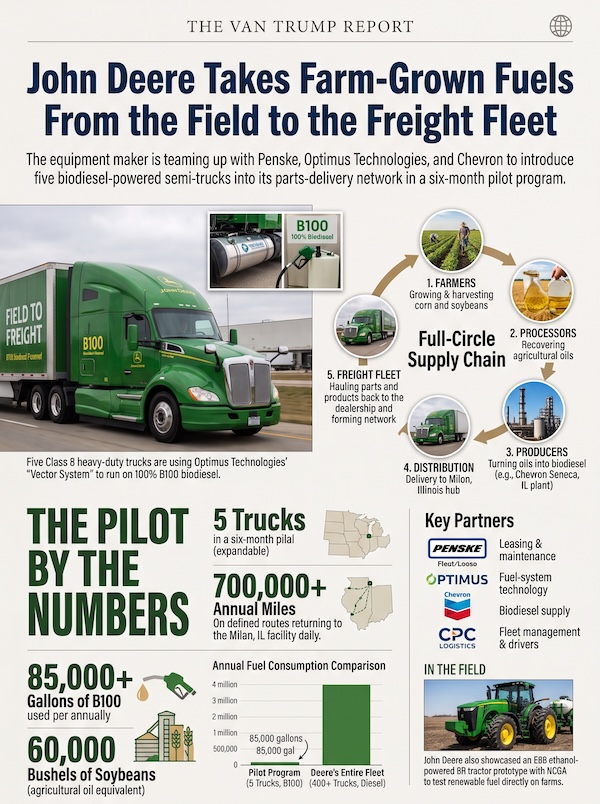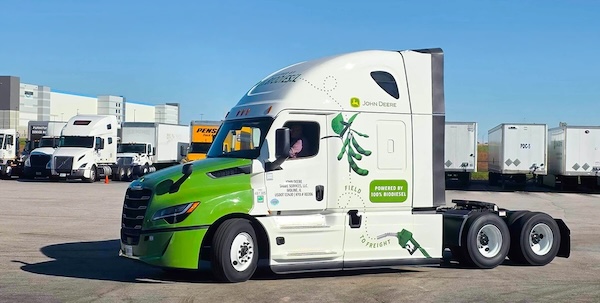



John Deere is putting crop-based fuels to work beyond the farm gate. The equipment maker has teamed up with Penske Truck Leasing, Optimus Technologies, and Chevron to introduce five biodiesel-powered semi-trucks into its parts-delivery network. The program, called “Field to Freight,” is part of a broader renewable-fuel initiative to build demand for the crops that Deere’s customers grow.
The trucks are part of a six-month pilot operating out of the company’s North American Parts Distribution Center in Milan, Illinois. The program puts five Class 8 heavy-duty trucks to work transporting Deere parts and products using Optimus Technologies’ “Vector System,” which enables conventional diesel engines to operate primarily on 100% biodiesel, known as B100.
Each partner brings a different piece of the operation. Penske provides the trucks through a full-service leasing arrangement that includes maintenance and over-the-road support. Optimus supplies the fuel-system technology, Chevron supplies the biodiesel, and CPC Logistics manages Deere’s fleet operations and drivers. The companies will evaluate reliability, maintenance, fueling, driver experience and operating economics during normal commercial service.
That structure will test whether B100 can fit into an established truck-leasing and service model without disrupting the everyday work of getting parts to customers. A successful deployment could provide a model for other fleets considering higher renewable-fuel use.
Although the trucks are equipped to use pure biodiesel, they retain a conventional diesel supply. The dual-tank system starts the engine on petroleum diesel and uses engine heat to warm the B100. Once conditions are suitable, it switches to biodiesel. Before shutdown, the system flushes the fuel lines with conventional diesel to prepare for the next start. It can also switch back to diesel if B100 is unavailable.
Fuel availability is an important part of the experiment. B100 is not readily available at commercial truck stops, so Deere installed a dedicated storage tank and pump at the Milan distribution center. The company selected long, defined routes on which trucks return to the facility daily, allowing them to refuel at the same location.
On an annualized basis, the five trucks are projected to travel more than 700,000 miles and consume more than 85,000 gallons of B100. The partners estimate that fuel volume represents agricultural oil equivalent to approximately 60,000 bushels of soybeans. Those figures describe a full year of operation, not the initial six-month demonstration. Chevron supplies the biodiesel from its Seneca, Illinois, facility, which uses primarily local soybean oil and distillers corn oil.
The initial fuel volume is modest compared with Deere’s overall transportation needs. Its nationwide logistics network includes roughly 400 semi-trucks and consumes nearly 4 million gallons of diesel annually. The five-truck demonstration will help the company assess whether broader B100 adoption makes sense across that network.
For Deere, the appeal is a supply chain that comes full circle. Farmers grow corn and soybeans, processors recover the oils, and a biodiesel producer turns those oils into fuel. Trucks then use that fuel to deliver parts to dealerships and ultimately back to farms.
Deere is also bringing the renewable-fuel concept directly into the field. Earlier this year, it publicly showcased an E98 ethanol-powered 8R tractor prototype at Commodity Classic, working with the National Corn Growers Association to demonstrate the technology and gather grower feedback. The prototype uses a 350-horsepower, 9.0-liter spark-ignition engine, with Deere reporting power characteristics similar to its diesel counterpart.
For Field to Freight, the next milestone is operating experience rather than another announcement. The partners need to establish how the trucks perform, what they cost to run and how well the fueling arrangement supports daily deliveries. Deere intends to keep the trucks in service and potentially expand the program if the trial succeeds. (Sources: EIN, Iowa Soybean Assoc., AgNavigator, AdvanceBiofuelsUSA)