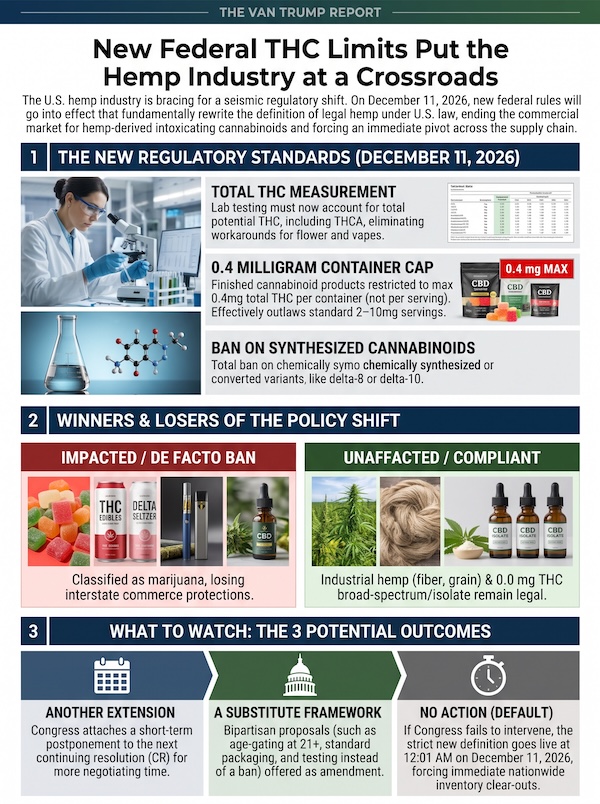



The U.S. hemp industry is bracing for a seismic regulatory shift. On December 11, 2026, new federal rules will go into effect that fundamentally rewrite the definition of legal hemp under U.S. law. Designed to close loopholes inadvertently created by the 2018 Farm Bill, these statutory changes will effectively end the commercial market for hemp-derived intoxicating cannabinoids and force an immediate pivot for manufacturers, distributors, and retailers across the supply chain.
The catalyst for this industry-wide disruption is Section 781 of Public Law 119-37, originally passed as part of the FY2026 federal funding package. While the provision was initially slated to take effect in mid-November, Congress recently passed a stopgap measure that split the implementation timeline.
A ban on completely non-naturally occurring cannabinoids—such as heavily synthesized chemical variants—takes effect on November 12, 2026. However, the broader, comprehensive restrictions, which include stringent new potency caps and testing methodologies, will go live nationwide on December 11.
The 2018 Farm Bill defined legal hemp largely by measuring delta-9 THC, capping it at 0.3% on a dry-weight basis. The incoming framework introduces three strict standards that redefine compliance:
- Total THC Measurement: Laboratory testing must now account for total potential THC, which explicitly factors in tetrahydrocannabinolic acid (THCA). This eliminates the compliance workaround for THCA flower and vapes, which previously passed legal thresholds by keeping delta-9 levels low prior to being heated.
- A 0.4 Milligram Container Cap: Finished hemp-derived cannabinoid products will be restricted to a maximum of 0.4 milligrams of total THC per container—not per serving. Given that a standard hemp-derived THC beverage or single gummy usually contains between 2 to 10 milligrams of THC, this strict packaging limit effectively outlaws current product formulations.
- Ban on Synthesized Cannabinoids: Cannabinoids created through chemical synthesis or conversion—such as converting abundant CBD isolate into delta-8 or delta-10 THC—are entirely excluded from the definition of hemp, regardless of their final THC concentration.
These regulatory changes will redraw the map of the legal cannabis industry. Intoxicating hemp products, including THC edibles, seltzers, and delta-8 vapes, face a de facto ban. Full-spectrum CBD products, which naturally contain trace amounts of THC that easily exceed the 0.4 mg per-container cap, will also be impacted, requiring major formulation adjustments.
Conversely, businesses focused strictly on CBD isolate or broad-spectrum products—where lab tests confirm 0.0 mg THC—will remain compliant. Traditional industrial hemp grown for fiber, stalk, and grain is protected under separate agricultural provisions and remains completely unaffected.
Because this statute rewrites the exception to the Controlled Substances Act, any product exceeding the new thresholds defaults to being classified as marijuana. Consequently, the interstate commerce protections afforded by the 2018 Farm Bill will vanish for non-compliant goods.
Shipping carriers, logistics partners, and payment processors are widely expected to sever ties with businesses moving these specific products to avoid federal liability. Even in states that have constructed their own regulatory frameworks and licensing programs for intoxicating hemp, federal law will supersede local policies in matters of interstate commerce and federal enforcement.
Because December 11 coincides with the expiration of current federal stopgap funding, the hemp industry has focused its lobbying efforts on three possible outcomes:
Another Extension: Congress could attach another short-term postponement to the next continuing resolution (CR) to buy time for negotiations.
A Substitute Framework: Bipartisan proposals (such as regulatory age-gating at 21+, standardized packaging, and testing standards instead of a container-level THC ban) could be offered as an amendment.
No Action (Default): If Congress fails to pass an intervention or passes a clean funding extension that omits a hemp rider, the definition will go live at 12:01 AM on December 11, forcing immediate nationwide inventory clear-outs. (Sources: JDSupra, Hemp Law Group, Congress.gov, Knoxville News Sentinel)