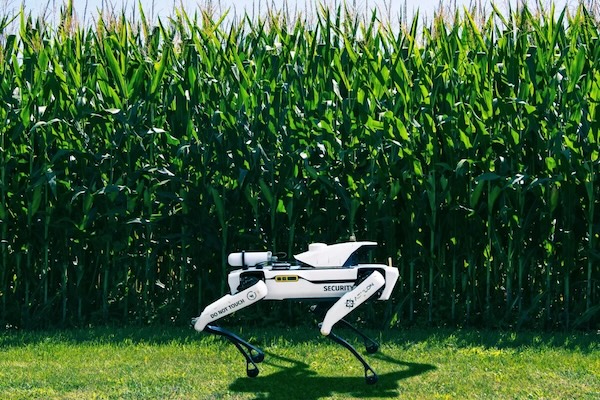



Quadrupedal “dog” robots are beginning to find a real, if still limited, place in agriculture. Their four-legged design lets them traverse uneven ground, narrow rows, and other terrain that can challenge wheeled machines, while carrying cameras, sensors, computing hardware, or treatment tools directly to the work area.
For now, most are used as mobile sensing platforms, collecting close-range information on crop growth, soil conditions, canopy health, weeds, livestock, and farm infrastructure. Over time, they could evolve from data collectors into autonomous “farm hands” that perform physical tasks.
Their strongest early applications are in high-value or difficult-to-access settings: orchards, vineyards, greenhouses, research plots, and livestock operations. These environments benefit from frequent, plant- or animal-level observation. Broad-acre row crops may eventually use quadrupeds for targeted scouting or intervention, but current deployments make the most sense where one inspection can uncover a costly disease outbreak, weed escape, animal-health issue, or equipment problem.
Boston Dynamics’ “Spot” is the best-known platform in this category. Marketed as a mobile inspection robot, Spot has been adapted by agricultural researchers for orchard scouting, crop inspection, and experimental weed control. Boston Dynamics says the robot can autonomously recharge, reroute around obstacles, self-right after a fall, and operate for about 90 minutes. The company reports more than 1,500 Spot robots in customer use.
Other companies are also supplying platforms for agricultural development. Unitree Robotics has drawn research interest for compact, programmable quadrupeds, while its Z1 robotic arm has been paired with Spot for precision weed treatment. Ghost Robotics’ Vision 60 has appeared in livestock research, where its larger, rugged frame may be better suited to open terrain and extended patrols.
Orchards offer some of the clearest field-trial evidence so far. In the United Kingdom, the RoboCrop project paired Spot with a custom payload developed by the Manufacturing Technology Centre and tested the system with fruit grower Bardsley England. The payload combined 4K cameras, onboard computing, and image-processing software to inspect apples for ripeness, quality, pests, and disease.
The MTC reported successful on-site testing and said the system demonstrated the operational value of autonomous mobile robotics, artificial intelligence, and vision systems for UK agriculture. Bardsley England operates across 26 sites and 850 hectares, offering a meaningful commercial orchard setting for the test.
Weed management is another promising use. Texas A&M researchers developed a robotic weed-flaming system using a Boston Dynamics Spot Mini quadruped as the mobile base, a six-degree-of-freedom Unitree Z1 arm, and a propane torch. Machine vision identifies weeds, and the arm directs heat toward their growing points, targeting weeds that escape conventional management later in the season.
That trial matters because it moves beyond sensing to plant-level action. A quadruped can bring a camera, robotic arm, and treatment tool into narrow or irregular areas where larger equipment may be less effective. Future systems could use the same mobility platform with lasers, mechanical removal tools, spot sprayers, or other precision-treatment methods. Field-scale throughput, however, remains a major challenge.
Livestock research suggests another opportunity. Spain’s SELF-AIR project tested quadrupeds in sheep-farming settings ranging from a two-animal farm to a research operation using Ghost Robotics’ Vision 60 with roughly 100 sheep. Researchers examined herd monitoring, animal-health observation, pasture navigation, and herding behavior.
The work also highlighted practical constraints. Sheep and cattle in some trials responded more quickly to a quadruped than to low-flying drones and appeared less stressed. Ground robots could guide animals through gates and along pasture paths, but reliable operation around unpredictable livestock remains difficult.
Commercial adoption still depends on solving several problems. Quadrupeds are slower than wheeled platforms, have limited payload capacity and battery life, and may require reliable connectivity for supervision and data transfer. Their cost currently confines most use to high-value crops, seed-breeding trials, research institutions, and specialized livestock applications. Wider farm adoption will depend on better batteries, stronger autonomy, lower hardware costs, and tools that deliver enough value to justify the investment. (Sources: Arxiv, DTN, The Guardian, The Engineer, Boston Dynamics)