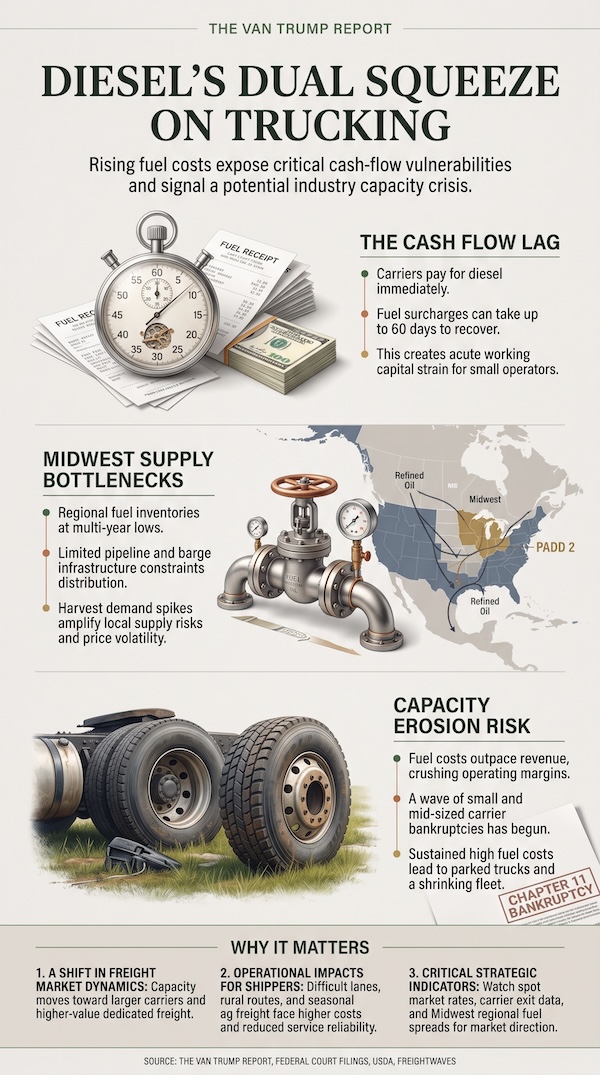



Many trucking industry experts see trucking heading toward a possible cash-flow and capacity crisis. Record diesel prices are inflating carriers’ daily cash needs, pressuring already-thin margins, and raising the risk that smaller fleets and owner-operators will park trucks or leave the market before freight rates fully adjust.
For trucking carriers, diesel is a large and immediate variable expense. Larger fleets may have negotiated fuel discounts, dedicated customer freight, fuel-surcharge mechanisms, and easier access to bank credit. Owner-operators and smaller fleets, by contrast, often buy fuel at retail, have fewer pricing protections, and rely more heavily on the spot market. Those carriers are especially exposed when the cost of fueling a truck jumps faster than base freight rates.
Fuel surcharges matter, but they do not eliminate the strain. The central problem is that carriers pay fuel costs immediately, but many recover surcharge revenue only after an invoice cycle that can extend to 60 days. A carrier can therefore be “protected” by a contractual fuel clause on paper yet run short of cash in practice.
In the Midwest, which is often referred to as “PADD 2” (the Petroleum Administration for Defense District II, representing the Midwest region) carriers face an even bigger strain. Diesel prices are typically higher and inventories are tighter due to a combination of seasonal demand and geographic distribution constraints. Roughly half of U.S. diesel production occurs along the Gulf Coast. Moving fuel up to the Midwest (PADD 2) relies heavily on pipelines (such as the Explorer and Centennial pipelines) and inland barge transport. When harvest demand spikes rapidly, regional pipeline infrastructure often runs at full capacity, creating localized supply bottlenecks. If local inventories are depleted, fuel cannot be transported from the Gulf Coast fast enough to suppress price spikes immediately.
PADD 2 diesel stocks have been sitting at the bottom of their five-year seasonal range for much of 2026, even as refinery runs in coastal PADDs 1, 3, and 5 increased. Seasonal refinery maintenance season, now getting underway, is expected to make it harder to rebuild any regional stockpile over the next couple of months, compounding the Midwest’s structural vulnerability.
Some carriers are already reportedly parking trucks because operating them is becoming infeasible and a wave of bankruptcies has swept the industry. At least 16 trucking, delivery and transportation companies entered bankruptcy proceedings between late August and Sept. 21, according to federal court filings and carrier records reviewed by FreightWaves. These were all small and mid-sized carriers. In total, it’s estimated that at least 150-250 transportation-related companies have filed for bankruptcy so far in 2026.
If diesel remains elevated through the autumn and winter, the industry likely sees more parked trucks, business closures, delayed equipment replacement, etc. This initially harms the small operator, but it ultimately changes market conditions for shippers as available capacity contracts. Essential lanes, dedicated freight, temperature-controlled loads, and large-shipper contract business receive trucks first; lower-value spot freight, rural lanes, seasonal agricultural freight, and difficult pickup-and-delivery locations become more expensive or less reliably served.
Industry insiders say the most important signals in the next several weeks are not the national diesel average alone, but whether the rest of the freight market confirms a deepening squeeze:
• Linehaul rates versus fuel surcharges: Rising invoices driven only by surcharges do not indicate a sustainable recovery in carrier economics.
• Carrier exits and parked equipment: These are early evidence of capacity erosion, especially among smaller fleets.
• Load-to-truck ratios and tender acceptance: Higher ratios and weaker acceptance can indicate that available capacity is becoming less flexible.
• Midwest wholesale diesel spreads and refinery operations: These indicate whether the regional fuel premium is temporary or becoming embedded during harvest.
• Grain-basis levels, elevator storage availability, railcar bids, and barge rates: These show whether fuel costs are being passed back to farmers through weaker cash bids and higher logistics costs.
• Consumer spending and industrial orders: These determine whether carrier capacity can eventually earn higher base rates or instead confront a high-cost, low-volume environment. (Sources: The Fuel Hedge, Freightwaves, CCJ, JPMorgan, USDA, Reuters, DAT)