




I want to thank our good friend Gary Lezak at Weather 20/20 for this piece of the puzzle as we move into this critical period. The next 30 to 60 days will likely determine a large portion of this year’s corn and soybean yield potential, making pollination, flowering, and early grain fill the most important weather period of the growing season. Research has consistently shown that weather during pollination has one of the greatest impacts on crop production, as just a few days of excessive heat, moisture stress, or severe weather can reduce kernel counts, affect pollination success, and ultimately lower final yield potential. A sharp contrast has already developed across the nation’s agricultural regions entering this period, with parts of the central Corn Belt receiving abundant moisture while portions of the Northern Plains remain significantly drier than normal.
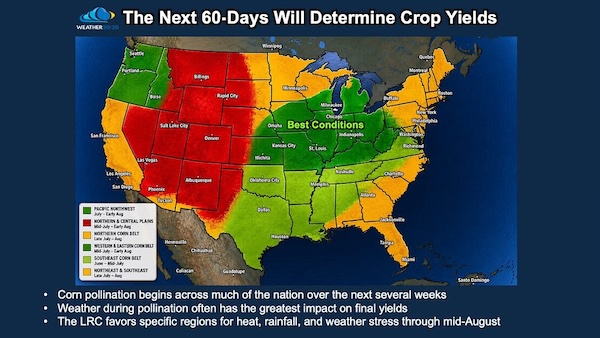
Over the past month, a significant shift has taken place across much of the nation’s agricultural heartland as moisture increased dramatically from the Gulf Coast northward through the Plains and into portions of the Midwest and southern Great Lakes. This broad corridor of above-average precipitation has covered many of the nation’s most important corn and soybean producing regions, improving soil conditions and providing a strong foundation. Because temperatures during the past month have averaged near to above normal alongside this rain, crop growth has accelerated, allowing many areas across the Corn Belt, Mid-South, and Central Plains to enter the critical pollination window with favorable moisture reserves and strong crop conditions.
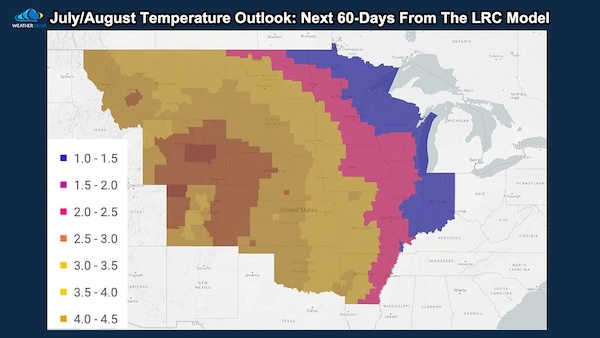
Looking at the long-range forecast guidance from the patent-pending LRC model, a broad region extending from Montana eastward to Indiana and southward into Oklahoma indicates a hotter-than-average July and August. The center of this forecast warmth is projected across portions of Colorado, Nebraska, and Wyoming, where temperatures may average four to five degrees Fahrenheit above normal during the peak of summer. While heat can benefit corn and soybeans when adequate moisture is available, persistent heat combined with limited rainfall during pollination will accelerate moisture loss and increase crop stress. The greatest concern for reproductive failure will be across these portions of the Central and Northern Plains, while areas farther east across much of the Corn Belt are forecast to experience less intense heat, helping to reduce stress during critical reproductive stages.

Rainfall trends through July and August will ultimately determine which areas achieve their yield potential and which regions experience severe crop stress. The LRC model indicates a highly favorable moisture corridor extending from Wisconsin southwestward through Iowa, Missouri, and into eastern Kansas, where rainfall totals are forecast to approach or exceed eleven inches. This heavy moisture aligns with some of the nation’s most productive corn and soybean acreage, which will comfortably support soil moisture reserves and offset periods of summer heat. In contrast, the LRC forecast places the center of a much drier weather pattern directly over Nebraska, where the combination of below-average rainfall and persistent four to five degree above-normal heat creates a high-stress risk for fast-moving moisture deficits and reduced crop potential.
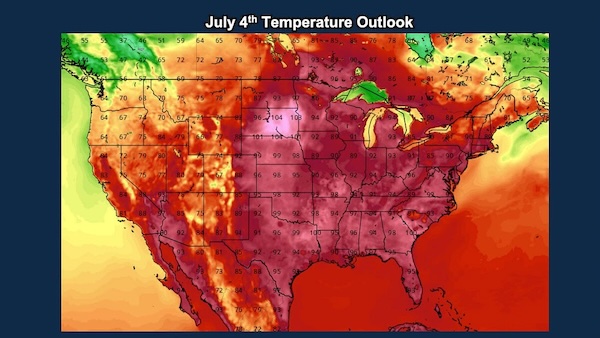
In the shorter term, the weather pattern remains highly active heading into the Independence Day holiday period as a strengthening heat-wave creating machine, expands near the Mexico-United States border. This setup creates a northwest flow highway along the northern and eastern edges of the ridge, triggering recurring thunderstorm complexes and severe weather outbreaks.
For corn and soybean fields across Kansas, Missouri, and parts of the Midwest, these complexes will bring highly beneficial, heavy rainfall to fields, though they also carry the localized risk of damaging straight-line winds, hail, and flash flooding. By the fourth of July, the jet stream is forecast to retreat, causing this storm highway to suddenly shut down and ushering in rather calm but incredibly hot conditions across most of the United States to kick off the core of summer. To learn more about Weather 20/20 and how their Dashboard is helping agribusiness clients stay one step ahead with their business decisions, click HERE.