


Global agriculture is entering a structural surplus era, and biofuels may be the most practical way to keep farms profitable while feeding the world. That is the central message of a new S&P Global Energy report, “Fueling agriculture – biofuels as the catalyst,” which argues that technology-driven productivity is outrunning traditional demand for food and fuel.
Over the past few decades, farmers have consistently produced more from the same land. World corn yields have risen about +1.5% per year, helping push global grain, oilseed, and fiber stocks to nearly 1 billion metric tons in 2025. US farmers, in particular, delivered another record harvest in 2025, extending what the report calls the largest-ever surplus of grains and oilseeds. These gains reflect advances in seed genetics, crop protection, machinery, and more recently, digital tools and data-driven management.
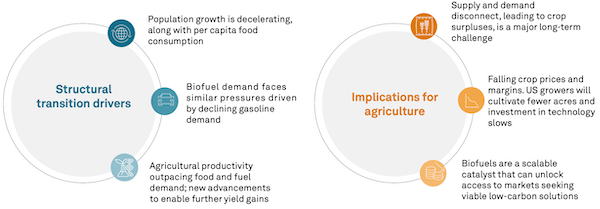
The problem, the report says, is on the demand side. Population growth is slowing, with global annual growth projected to fall to around -0.4% by 2050 as fertility rates approach replacement levels and some major economies experience outright population declines. Per-person consumption of staple grains such as wheat and rice has mostly leveled off, while per-capita barley consumption has trended lower for decades. Meat consumption, which historically helped drive additional demand for feed grains and oilseeds, is also reaching saturation in many markets. The study notes that global per capita meat demand growth has already slowed from about +2.4% a year since the late 1990s to +0.7% by 2025, and is expected to rise only about +0.1% annually toward 2050.
Biofuel demand, one of the other big outlets for crops, is under its own pressure. More efficient engines, changing driving patterns, and growing adoption of electric vehicles are all weighing on gasoline use. At current US ethanol blend rates of around 10%, S&P Global estimates that on-road ethanol demand could fall by nearly half, to roughly 6.6 billion gallons by 2050. Without new sources of demand for feedstocks, that drop would leave a widening gap between what farms can produce and what fuel markets can absorb.
The stress is already showing up in US farm structure. Between 2002 and 2022, the United States lost 209,000 farms and 58 million acres of farmland, with the steepest losses between 2017 and 2022, when 20 million acres disappeared. The report models a scenario in which US ethanol blend rates stay flat near today’s levels and no major new feed demand appears. In that case, US corn growers would cultivate about -31% fewer acres by 2050, equivalent to halting production on an area roughly the size of North Carolina. S&P Global describes this as a long-term structural challenge rather than a temporary downturn.
Rather than focusing on cutting production, the study makes the case for finding new, scalable markets. It identifies biofuels as the most promising candidate, provided they are backed by technology, supportive policy, and market incentives. The authors argue that the next wave of agricultural growth will be driven by “stacked technologies,” including biotechnology, gene editing, improved crop protection, regenerative farming practices, digital agriculture, and artificial intelligence. Under an “optimized” scenario where these tools are widely adopted, US corn yields could increase about +1.6% per year through 2050, lifting output by roughly +50% without adding acreage. Globally, corn production could rise more than +80% by mid-century, mainly by closing yield gaps with existing technology rather than expanding cropland.
In that technology-enabled future, biofuel production scales significantly. The report suggests that global biofuel output could triple or more by 2050, and ethanol could supply a much larger share of the road motor gasoline market than today, or extend further into sectors such as aviation, marine transport, and biomaterials. At the same time, ethanol plants and other biofuel facilities generate co-products like protein meals and distillers dried grains with solubles (DDGS), which flow back into the feed system. In the modeled optimized scenario, selected countries see food and feed supplies rise about +45% by 2050 compared with 2025, even as biofuel output climbs.
The report also touches on policy frameworks and blend rates as critical levers. Existing mandates and incentives have helped support biofuel demand, but the authors argue that further progress will depend on policies that recognize biofuels as a low-carbon option in the broader energy mix. Higher blend rates in gasoline and diesel, or wider adoption of higher-ethanol fuels in appropriate vehicles, are presented as ways to unlock additional demand for agricultural feedstocks. The study points to recent episodes of oil and gasoline price volatility, such as supply disruptions and geopolitical shocks, as reminders of the value of domestically produced renewable fuels in supporting energy security and moderating price swings.
Overall, S&P Global challenges the traditional “food versus fuel” framing. In its view, the core question is not whether to use land for food or biofuel, but whether agriculture adapts to structural surplus or falls into stagnation. By focusing on productivity gains on existing farmland, and by routing more of that output into biofuels and associated co-products, the report argues that the sector can keep farms viable, reinforce rural economies, and contribute to food, energy, and climate goals at the same time.
The full report, which was commissioned by “U.S. Farmers and Ranchers in Action,” is available HERE.