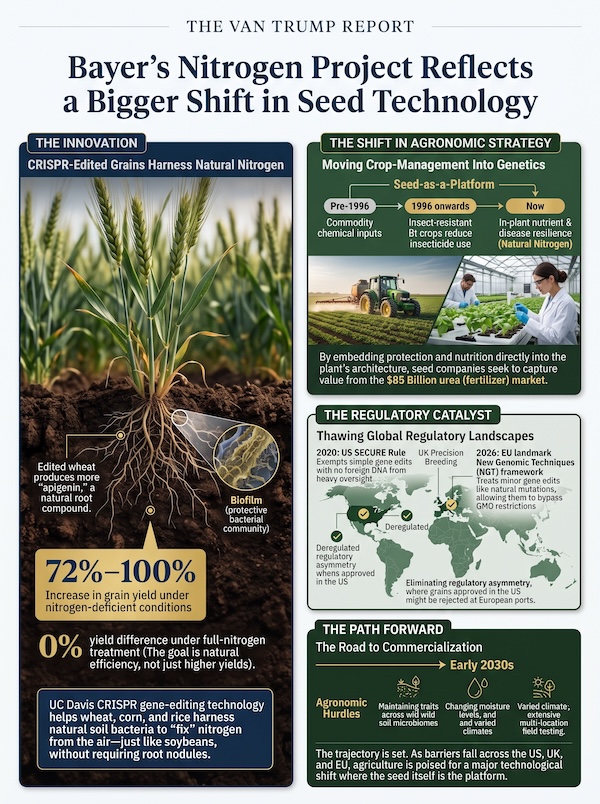



Bayer has licensed a UC Davis gene-editing technology that could help cereal crops obtain more nitrogen from soil bacteria, potentially reducing their dependence on fertilizer. The project also reflects a broader direction in the seed industry: building more agronomic capabilities into the plant, from insect and disease protection to improved nutrient supply. That strategy is gaining new regulatory support in some markets as governments establish less restrictive pathways for certain gene-edited plants.
The Bayer-licensed technology comes from a team led by Eduardo Blumwald, a distinguished professor in UC Davis’s Department of Plant Sciences. The CRISPR gene-editing technology is designed to help staple cereal crops—like wheat, corn, and rice—harness natural soil bacteria to “fix” nitrogen from the air, similar to legumes like soybeans.
Instead of trying to force these crops to grow soybean-like root nodules, the team edited wheat to produce more “apigenin,” a naturally occurring compound released through its roots. Apigenin encourages nitrogen-fixing bacteria to form biofilms, protective communities that create the low-oxygen conditions needed for the bacteria’s nitrogen-fixing enzyme to function.
In controlled experiments, edited wheat produced 72%–100% more grain than unedited wheat under nitrogen-deficient conditions. Under the study’s full-nitrogen treatment, researchers found no yield difference between edited and unedited plants. But the point is not to boost yields beyond typical fertilizer applications. The significance of the technology is the potential to unlock crops that currently depend on fertilizer.
Moving crop-management functions into genetics is not new. Insect-resistant Bt corn and cotton have been commercially available since 1996, and USDA research links their adoption to reduced insecticide use. Newer breeding and gene-editing programs seek to extend seed-delivered benefits into even more areas.
By moving agronomic capabilities into the plant’s intrinsic architecture, seed companies hope to capture value that used to be spent on commodity chemical inputs. Bayer, for instance, says the nitrogen fixing technology could help it tap into the $85 billion urea market – if nitrogen-fixing grains are widely adopted, part of farmers’ spending on urea would shift toward seeds.
This transition is accelerating rapidly due to a thawing global regulatory landscape. Historically, any genetic modification faced a steep, expensive, and years-long regulatory climb. The United States broke from this in 2020 with its SECURE Rule, exempting simple gene edits—those containing no foreign DNA—from heavy oversight.
Now, Europe has followed suit, effectively unlocking the global market. Following the UK’s move to ease rules on “Precision Bred Organisms,” the European Union passed its landmark New Genomic Techniques (NGT) framework in 2026. This legislation treats plants with minor genetic edits like natural mutations, allowing them to bypass the rigid restrictions and labeling requirements of the EU’s older GMO directives.
Some seed companies see it as a watershed moment. It eliminates the “regulatory asymmetry” that previously threatened global grain trade, where a crop approved in the US might be rejected at a European port. Furthermore, the 2026 EU framework actively incentivizes exactly what Bayer is doing: using tools like CRISPR to tweak a plant’s native biochemical pathways rather than relying on classical transgenics.
While the regulatory doors are opening, real-world agronomic hurdles remain. Companies must ensure that traits like the apigenin signal work consistently across wildly different soil microbiomes, moisture levels, and climates, all without draining the plant’s energy and reducing the final harvest yield. Because of the extensive backcrossing and multi-location field testing required, broad commercial availability for these self-fertilizing cereals is likely slated for the early 2030s.
Nevertheless, the trajectory of the industry is firmly set. As the legal barriers to precision gene editing fall across the US, UK, and EU, agriculture is poised for a major technological shift, one where seed itself is the platform. (Sources: Bayer, UC Davis, Bloomberg, SciTech)