


Soil is often called the world’s most under-appreciated natural asset. It sustains global food production, holds water, hosts vast biological communities, and stores vast amounts of carbon. Yet, despite its critical role, agricultural soil remains one of the most fragmented and poorly understood resources in modern farming.
Enter the Varda Foundation, a non-profit organization building digital infrastructure designed to unify soil and field data across the global agricultural supply chain. Varda’s view is that once this information is made interoperable, discoverable, and connected to specific places, it can support better decisions across agriculture and beyond
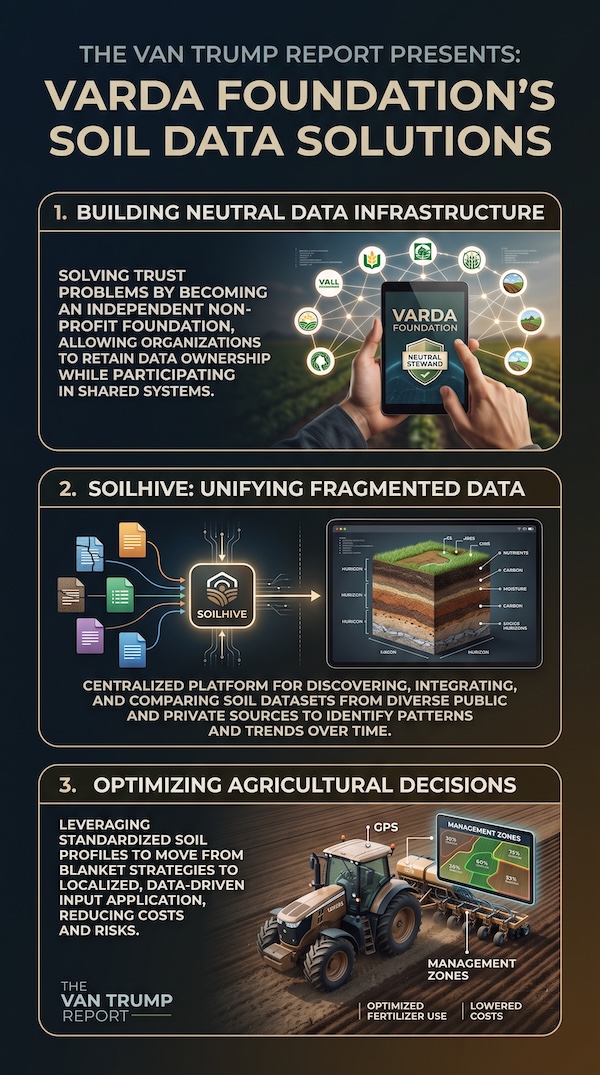
Varda Foundation began as Varda AG, a venture associated with crop nutrition giant “Yara International,” but later transitioned into an independent foundation. Despite always operating independently, Varda found that many organizations are reluctant to share sensitive land and soil information into systems they think might advantage a private corporate owner. So in 2025, it became an independent not-for-profit foundation, freeing it from corporate ties. By presenting itself as a neutral steward of shared infrastructure, the foundation is trying to solve a trust problem as much as a technical one. Its public materials say that organizations can retain ownership and control of their own data while still participating in a broader interoperable system.
The center of this approach is “SoilHive,” Varda’s soil-data platform. SoilHive is designed to help users discover, compare, and integrate soil datasets from multiple sources, including public and private contributors. Public descriptions of the platform say it contains hundreds of thousands of georeferenced soil-data points, more than a thousand raster layers, and observations spanning more than a century. As Varda points out, the value of soil data does not come only from a single soil test. It comes from assembling a large enough body of information to identify patterns, compare locations, measure change over time, and build decision tools on top of those patterns.
Soil data only becomes broadly useful if it can be attached reliably to a specific piece of land. Varda tackles this aspect with “Global FieldID” (GFID). Described as the “Google Maps” identifier for agriculture, GFID assigns a unique, persistent digital ID to farm land plots. This allows seamless data exchange across different software tools, farm management information systems (FMIS), and supply chain partners.
To Varda and a growing community of agronomists, access to reliable, standardized soil data is essential for the practical future of farming. Granular, localized soil profiles enable growers to move away from blanket fertilizer strategies and instead optimize inputs, directly lowering operating costs. Furthermore, as corporate buyers and carbon initiatives offer financial incentives for regenerative practices, harmonized soil data provides the verified baselines needed to prove carbon sequestration and soil health improvements over time. Standardized records also help farmers identify compaction and erosion risks before they turn into major yield penalties during severe weather events.
Still, there are important limits to the idea. Raw soil data does not automatically translate into value. Sampling methods differ. Depths and time periods differ. Metadata can be incomplete. Geographic coverage can be uneven. Private contributors may place restrictions on access or reuse. Even when the data is clean and well governed, the market still has to prove that better soil information leads to better underwriting, better recommendations, or stronger financial outcomes. In that sense, Varda is building enabling infrastructure rather than delivering a guaranteed monetization formula.
The strongest version of Varda Foundation’s argument is therefore not that soil data should be treated like a speculative commodity. It is that soil data can become durable infrastructure for agricultural intelligence. If the foundation succeeds, the economic value will come from turning invisible and fragmented records into a trusted system that supports better decisions across production, risk, sustainability, and capital allocation. In that model, soil data becomes valuable for the same reason maps, standards, and identifiers become valuable: they lower friction, improve coordination, and make many other forms of analysis and commerce possible. Learn more at Varda Foundation HERE. (Sources: AgNavigator, iGrow, Coalition for Soil Health)