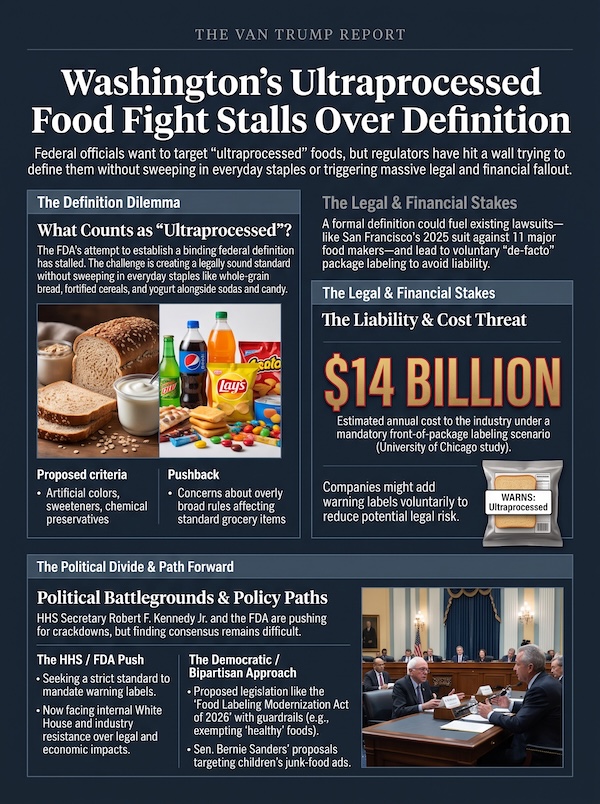



Federal health officials have been threatening to crack down on “ultraprocessed” foods since President Trump regained the White House. Health and Human Services (HHS) Secretary Robert F. Kennedy Jr. blames the foods for a slew of health problems and wants to ultimately require labels on the front of food packages to warn consumers off. Before that can happen, regulators must settle what the term means, but that effort appears to have hit a wall…at least for now.
Recent reports indicate that the push by Kennedy and FDA to establish a binding federal definition for ultra-processed foods (UPFs) has run into significant delays and internal resistance. FDA officials have publicly acknowledged that formulating a legally sound, non-arbitrary definition proved much more difficult than anticipated. Applying broad classification systems risked sweeping in staple, nutrient-dense items like whole-grain breads, fortified cereals, and yogurt alongside sodas and confectionery.
The food industry and the White House have reportedly both raised concerns over potential legal ramifications of a definition for “ultraprocessed.” FDA officials previously discussed a proposed definition that would classify foods containing ingredients such as artificial colors, sweeteners, or chemical preservatives as ultraprocessed. However, White House staff pushed back over concerns that it would encompass a large share of grocery-store products and potentially bolster existing lawsuits linking those products to adverse health effects.
A definition would not create the lawsuits from scratch — some are already underway. For example, San Francisco sued 11 major food manufacturers in December 2025, alleging violations of California’s unfair competition law and public-nuisance law through the creation and promotion of unhealthy products. The reported industry concern is that a federal classification could lend additional support to such claims.
Because of the way consumer protection laws are interpreted, a federal definition could also lead to de facto package labeling across the food industry. Meaning, even without a law mandating labels for foods deemed “ultraprocessed,” companies would put them on packaging anyway in order to reduce potential legal liability. A University of Chicago study puts the potential additional industry bill at roughly $14 billion annually under a mandatory front-of-package labeling scenario. That estimate gives businesses a reason to follow the debate.
A big question now is whether Kennedy and FDA might join forces with sympathetic Democrats to support an ultraprocessed definition. While there is demonstrated Democratic support for defining ultraprocessed foods, that is not the same as supporting Kennedy’s particular definition, which has not yet been publicly released.
Democrats have proposed legislation that would address the issue. The “Food Labeling Modernization Act of 2026” would require FDA to define terms including “ultraprocessed” and “not ultraprocessed.” Their approach also has notable guardrails, such as excluding foods meeting FDA’s “healthy” criteria from the ultraprocessed category. Additionally, Senator Bernie Sanders, an independent who caucuses with Democrats, has proposed legislation requiring warning labels and restricting junk-food advertising directed at children, both of which have some bipartisan support. (Sources: Bloomberg Law, FDA, Scientific American, Feedstuffs)