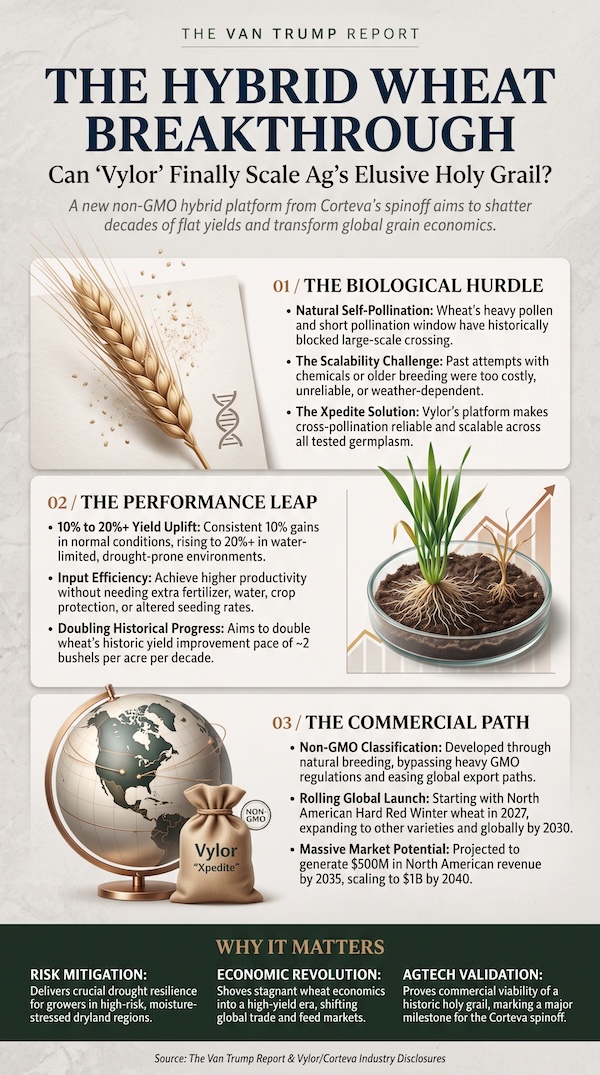



For decades, the agricultural industry has been chasing what many considered a holy grail: commercially viable hybrid wheat. Corteva spinoff “Vylor” claims to have finally cracked the code, so to speak, with its new “Xpedite” platform, which is designed to make it practical to produce hybrid wheat seed at commercial scale. Vylor is Corteva’s former seed-and-genetics business that became an independent company in October.
Farmers are familiar with hybrid seed in corn and other crops. Hybrid seed is produced by crossing two distinct parent lines. The resulting plant can benefit from what breeders call “hybrid vigor”—in plain terms, the offspring may perform better than either parent in areas such as yield, stress tolerance, or consistency.
That concept has been hard to bring to wheat. That’s partially due to biology. Wheat is naturally self-pollinating. The pollen is also very heavy and has a very short window for pollination. In simple terms, wheat likes to keep to itself, making it incredibly difficult to cross-pollinate two different varieties on a massive, cost-effective scale.
Previous attempts to force wheat to hybridize—often using chemicals or older breeding techniques—proved unreliable. They were easily disrupted by unexpected weather or only worked with a tiny fraction of wheat varieties.
Vylor says its Xpedite system outsmarts these biological hurdles, making hybrid seed production more reliable and scalable. The company says the technology has worked across all wheat germplasm it has tested, meaning it could be used with a wide range of wheat breeding material rather than only a narrow group of parent lines.
The company’s early research points to a meaningful yield opportunity. Vylor says its first-generation hybrids have shown yield potential of 10% or more above elite commercial wheat varieties in moderate- to high-yield environments. In water-limited trials, the company says the advantage reached 20% or more.
That claim will likely attract attention across the hard red winter wheat belt, where moisture is often the central production risk. A wheat crop that holds yield better during drought or uneven rainfall could help growers manage one of the biggest uncertainties in dryland farming.
Vylor has reported three years of large-scale testing across more than 60 locations, with a consistent 10% yield advantage over leading conventional varieties. It also says the reported gain did not require more fertilizer, water, crop-protection applications, or changes in seeding rates.
Historically, wheat yields have crept up at a modest pace—improving by about two bushels per acre every ten years. Vylor expects its new platform to literally double that rate of improvement over the coming decades.
Vylor describes Xpedite wheat as non-GMO. The hybrids are created through breeding and crossing rather than by inserting genetic material from another organism. That means the products are not expected to require the type of regulatory approval associated with GMO crops. It should also have an easier path to gaining export approval from US trade partner nations.
Vylor is moving fast to get this technology into the hands of growers. The initial commercial launch is slated for 2027 in North America, starting with Hard Red Winter wheat. Soft Red Winter wheat will follow in 2029, and by 2030, they plan to roll out Hard Red Spring wheat alongside a broader international expansion. The company projects these wheat hybrids will generate $500 million in North American revenue by 2035, scaling up to $1 billion by 2040. (Sources: AgNavigator, iGrow News, Agbull)