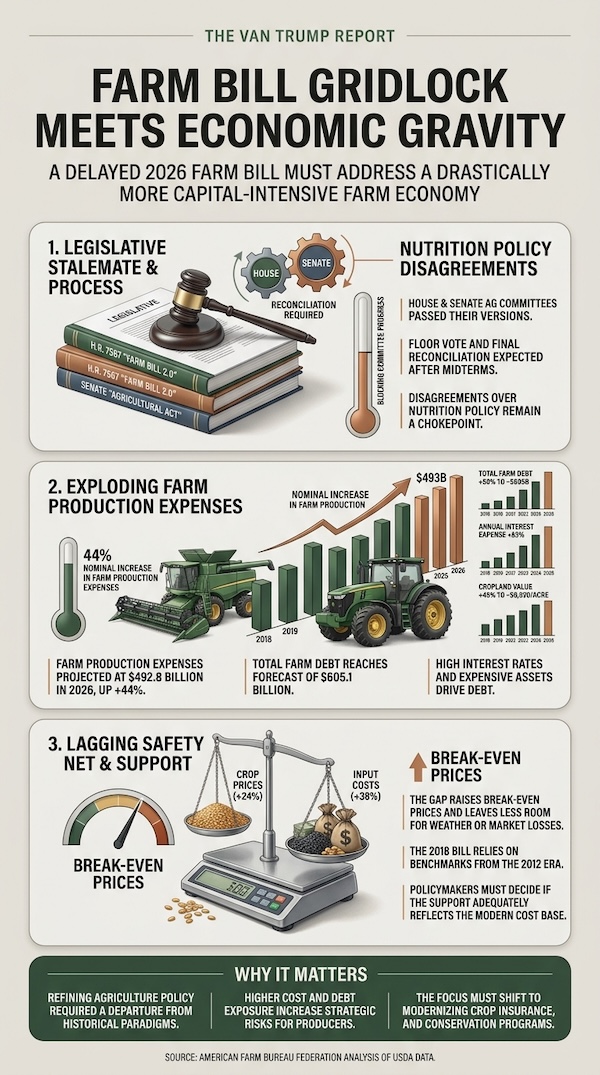



Congress has made more progress on the 2026 Farm Bill than in the previous three years, but the legislation has a ways to go before becoming law. The House has passed its bill, and the Senate Agriculture Committee has reported its version, leaving Senate floor action and a potentially difficult House-Senate negotiation before a final measure can reach President Trump. The current extension of the 2018 Farm Bill expired September 30.
The good news for most producers is that the largest farm safety-net changes already occurred through the 2025 budget reconciliation law. Still, that legislation failed to fully address many key issues, such as year-round E15 and mandatory country-of-origin labeling (MCOOL). Both the Senate and House versions of the 2026 Farm Bill make changes to federal crop insurance and conservation programs, raise maximum USDA loan amounts, and boost mandatory funding for trade and market access promotion, among other things.
Where the Bill Stands in Congress – The House passed H.R. 7567, the “Farm, Food, and National Security Act of 2026,” aka “Farm Bill 2.0,” on April 30, 2026. The bill was then received in the Senate, where agriculture lawmakers have been working from a separate proposal, the Agricultural Act of 2026. The Senate Ag Committee passed its version on September 16. The bill is currently on the Senate legislative calendar awaiting a full floor vote. Because the House and Senate versions differ, the two bills will then need to be reconciled before the legislation can head to the President’s desk to be signed into law. Leaders in the Senate have said they expect a full Senate vote and final reconciliation later this fall following the midterm election recess. The main political challenge remains nutrition policy. Disagreement over SNAP rules and state administrative responsibilities previously blocked committee progress, and it could complicate Senate floor action or the eventual negotiation between the chambers.
The policy debate is occurring against a farm economy that is materially different from the one Congress considered when it passed the 2018 Farm Bill. The Agriculture Improvement Act of 2018 was signed into law in December 2018, but its underlying commodity-policy structure relied heavily on reference prices and program parameters developed years earlier, including benchmarks rooted in the 2012 Farm Bill era. That lag is central to the current debate.
According to an American Farm Bureau Federation analysis, agriculture is now substantially more capital-intensive, with operating costs and borrowing needs rising faster than crop prices in many cases. Major changes since 2018 include:
Farm production expenses: Projected 2026 expenses total $492.8 billion, up from about $343 billion in 2018—a nominal increase of nearly $150 billion, or +44%. Even adjusted for inflation, expenses are more than $47 billion higher.
Input costs versus crop prices: USDA’s crop-input prices-paid index rose more than +38% between July 2018 and July 2026, while the crop prices-received index increased about +24%. The gap raises break-even prices and leaves less room to absorb weather losses, lower yields or softer markets.
Farm debt: Total farm-sector debt is forecast at $605.1 billion in 2026, compared with $402.6 billion in 2018—an increase of roughly +50%.
Interest expense: Annual farm-sector interest expense is projected at $33.8 billion in 2026, nearly +63% above the $20.7 billion recorded in 2018. Higher rates, larger operating loans and more costly land and equipment all contribute.
Land and rents: Average cropland value has risen from about $4,130 per acre in 2018 to $6,020 in 2026, a gain of nearly +46%. Average cropland cash rent increased from approximately $138 to $160 per acre.
Higher farmland values have improved equity for many landowners and can support borrowing capacity. But they do not necessarily improve annual cash flow, and higher land prices and rents can make it harder for beginning farmers, tenants and expanding operations to compete for acres. The policy challenge is therefore more specific than simply renewing an expired law. Congress is deciding whether the farm safety net, crop-insurance structure, credit programs, conservation incentives and other support systems adequately reflect today’s higher cost base and greater financing exposure. (Sources: Senate Ag, US House, University of Illinois, Farm Bureau, DTN, NorthernAg Network)