


For generations, the economics of a feedlot were relatively straightforward. Buy cattle, buy feed, add weight efficiently, manage risk, and sell finished animals. That basic business is not disappearing, but a project recently broke ground in Broken Bow, Nebraska that suggests the modern feedlot may eventually be worth more than the cattle flowing through it.
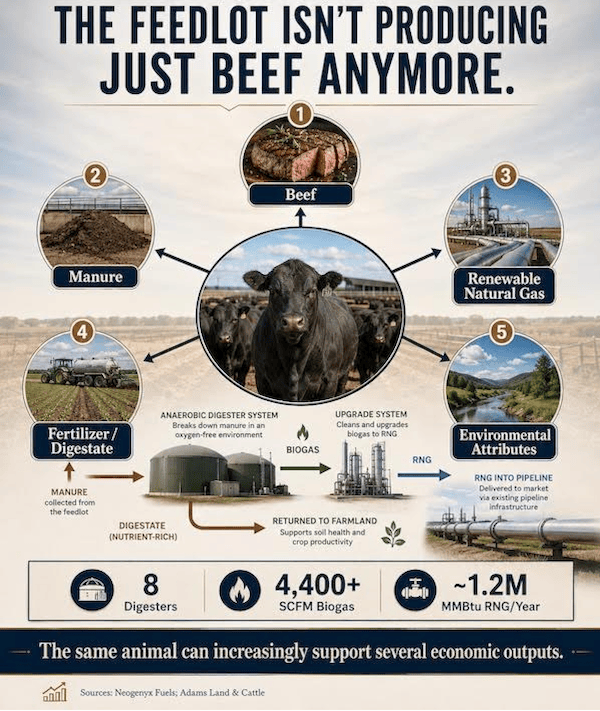
Adams Land & Cattle and Neogenyx Fuels officially broke ground on a large renewable natural gas project at the Adams feedlot. The planned system will use eight anaerobic digesters to process cattle manure, generating more than 4,400 standard cubic feet per minute of biogas and upgrading it into roughly 1.2 million MMBtu of pipeline-quality renewable natural gas per year. The developers estimate the project could avoid approximately 63,700 metric tons of CO2-equivalent emissions annually.
At first glance, this looks like another manure-to-energy project, but I think the bigger story is that agriculture is quietly entering an entirely different market. The cattle going through Adams Land & Cattle already create beef. Now the manure coming out the other side can become natural gas. The digestate remaining after that process can be reused as livestock bedding and agricultural fertilizer. The methane captured from the manure can generate environmental value, and the resulting renewable gas may eventually serve transportation markets far removed from Nebraska agriculture.
What makes the Broken Bow project especially interesting is where Neogenyx believes some of this energy could ultimately go. The company has explicitly connected agricultural renewable natural gas with the emerging market for Bio-LNG used by international maritime shipping. Renewable gas produced from cattle manure can be upgraded, liquefied and potentially sold into shipping markets looking for lower-carbon fuel alternatives. A feedlot in central Nebraska helping fuel an ocean-going vessel halfway around the world would have sounded bizarre not very long ago, but that is exactly why this is more than manure management. It is agriculture becoming part of the global energy supply chain.
The capital implications are worth watching closely. Large feedlots have always been valuable because of cattle capacity, feed availability, grain relationships, water, labor, logistics and proximity to packing plants. But if manure can generate meaningful recurring energy revenue, investors may eventually begin valuing some large livestock operations partly as energy-feedstock platforms. A large concentrated feedlot does not simply represent cattle throughput; it represents a predictable stream of organic material generated every day, and predictable feedstock has value.
Energy infrastructure investors generally like projects where they can understand where the raw material is coming from and how much will be available. A large livestock facility potentially offers something many other renewable projects struggle to provide: a steady, controlled and relatively measurable supply of feedstock located in one place. That may explain why agriculture continues attracting sophisticated energy developers. The manure was already there. The question is whether technology, energy markets and environmental incentives can make extracting value from it worthwhile.
If the answer increasingly becomes yes, producers and livestock operators need to think differently about contracts surrounding these projects. Who owns the manure? Who owns the gas? Who receives the value of the environmental attributes? Who controls the digestate? How long is the agreement? Who pays for repairs and downtime? Does the feedlot receive a fixed payment, a revenue share or some combination? What happens if renewable fuel credits become dramatically more valuable? Those questions may sound secondary compared with cattle procurement or feed costs today, but they will not feel secondary if energy revenue becomes a meaningful percentage of enterprise earnings.
Manure rights could start looking a lot more like mineral rights, and the same is true for the infrastructure surrounding the operation. A feedlot located near a natural gas pipeline may have an advantage over an identical feedlot 75 miles away. Access to gas interconnection matters. Electricity matters. Water matters. Nearby fertilizer demand matters. Transportation infrastructure matters. If Bio-LNG becomes a larger global market, access to the broader natural gas network connecting production areas to liquefaction and export facilities could matter too.
That creates an intriguing second-order possibility: energy economics might eventually influence where livestock production grows. Historically, cattle feeding gravitated toward places with grain, cattle, favorable climate, water and packing capacity. Those fundamentals are not going anywhere, but imagine two potential feedlot locations with roughly equal cattle economics. One has pipeline access and the ability to monetize manure through RNG production. The other does not. Over time, the first location could become more valuable.
There is also a broader capital-allocation lesson here. For years, agriculture has tried to improve profitability mostly by increasing output from the primary product: more bushels per acre, more pounds per animal, better feed conversion and faster throughput. Increasingly, another path is emerging: find more products inside the same production system. Corn became food, feed, ethanol, distillers grains, corn oil and carbon opportunities. Soybeans became meal, oil, renewable diesel feedstock and increasingly sustainable aviation fuel feedstock. Large livestock operations may follow the same path, with the animal producing beef while the production system also generates renewable gas, fertilizer products and environmental credits.
That does not mean every digester will make money or that manure suddenly becomes a gold mine. Renewable natural gas economics remain heavily dependent on construction costs, operating performance, energy markets, environmental incentives and project structure. But the direction is important. The most sophisticated operators may increasingly stop asking only, “How much money can we make feeding cattle?” and begin asking, “How many revenue streams can we responsibly build around the cattle we are already feeding?”
The Broken Bow project provides one glimpse of what that might look like. A Nebraska feedlot is taking something that historically had to be hauled, stored and managed as a cost and turning it into pipeline-quality fuel with potential access to global transportation markets. That should force us to reconsider what exactly we are looking at when we value a large livestock operation. At some point, the cattle may no longer be the only valuable thing inside the fence, which leads to the bigger question: At what point does the manure coming out of a feedlot become valuable enough that we need to rethink what the feedlot itself is worth? (Source: neogenyx, nasdaq)