


For over a year, the US border was closed to live Mexican cattle to keep out the New World screwworm (NWS). Now, the US Department of Agriculture is slowly reopening border entry points under strict inspection rules. While consumers will no doubt welcome relief at the grocery store, but the decision has split the livestock industry right down the middle.
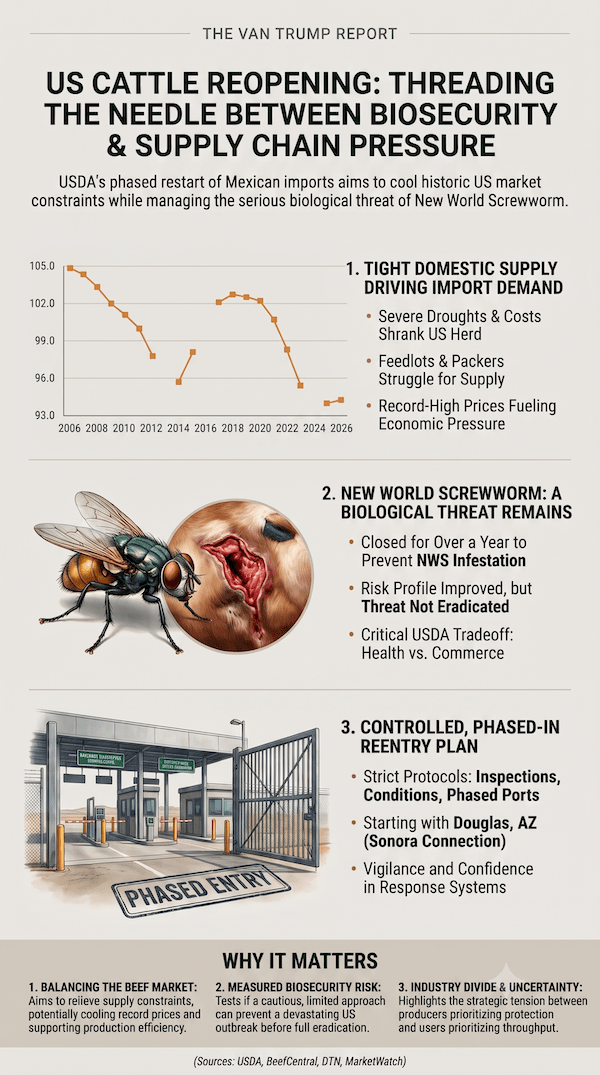
USDA’s decision boils down to a tradeoff between animal-health risk and supply-chain pressure. USDA believes the risk profile has improved enough to justify a controlled restart. Secretary Brooke Rollins said the closure had been “tough but necessary” to slow the spread of screwworm in Mexico, but that conditions now allow a limited reopening beginning with Douglas, Arizona, followed by possible expansion to Santa Teresa and Columbus in New Mexico if Mexico keeps meeting its Joint Action Plan. USDA says there has been no notable increase in reported NWS cases in Mexico, nor any northward movement of NWS over the past eight weeks.
The key reason USDA even considered the option is the tight US cattle market. The US herd has shrunk to its smallest size in 75 years due to severe droughts and high operating costs. Importing Mexican cattle helps feedlots replenish supplies, and packers say it supports consumer demand when domestic cattle numbers are constrained. In other words, the USDA is bringing back Mexican cattle imports to boost supply and cool record-high prices.
Proponents argue the phased plan is the safest way to reopen. Industry groups such as the National Cattlemen’s Beef Association and the Meat Institute have endorsed a careful restart, saying USDA’s approach reflects both vigilance and confidence in the response system. They also note that Sonora (Douglas, AZ crossing) and Chihuahua (San Teresa and Columbus, NM crossings) have relatively strong animal-health infrastructure and are geographically farther from the areas in Mexico where screwworm has been concentrated, which makes the first reopening step look more manageable than a full border reset.
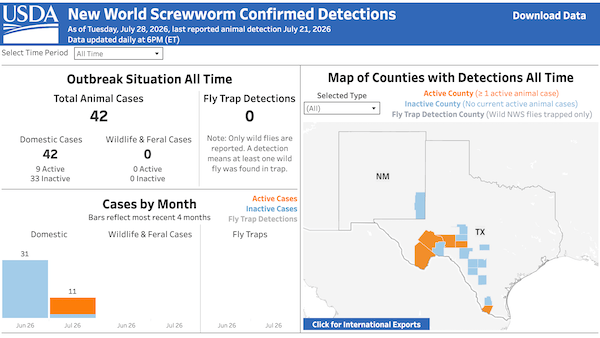
Opponents are focused on the biological risk. R-CALF USA argues that reopening the border, even partially, could incentivize more cattle movement from southern Mexico, where screwworm remains endemic, and therefore increase the odds of fresh US infestations. That group says the border should stay closed until Mexico fully eradicates the pest within its borders and can show the problem is again contained farther south.
Critics also say USDA moved too slowly and that the disease threat remains too serious for a reopening now. Texas Agriculture Commissioner Sid Miller praised the limited resumption but said the decision should have come sooner, while still warning that the agency has not gone far enough in addressing the broader threat. That split reaction captures the politics of the issue: cattle users want supply relief, but producers most exposed to disease risk want a stricter standard.
Bottom line, USDA is trying to thread a narrow needle. It wants to relieve pressure on the cattle market and reestablish a long-running trade flow, but it is doing so only after an extended shutdown, with inspections, phased ports, and Mexico-facing conditions attached. The debate now is whether that caution is enough, or whether reopening before total eradication leaves the industry exposed to an even more active outbreak. (Sources: USDA, BeefCentral, DTN, MarketWatch)