


House Ag Committee Chairman Glenn “GT” Thompson (R-Pa.) has introduced new legislation that would overhaul the country’s H-2A guest worker program. Known as the “Securing Agriculture’s Workforce Act” (SAWA), the bipartisan bill would address farm labor shortages, especially for year‑round operations, while locking in a more predictable wage framework for employers. It does not create a path to citizenship but instead expands and restructures temporary visas, shifts some authority from Labor to USDA, and codifies recent wage-rule changes that producers have been using under an interim final rule.
SAWA was introduced in June 2026 by House Agriculture Committee Chair Glenn “GT” Thompson (R‑PA), with Democratic co‑lead Rep. Don Davis (D‑NC), framing it as a response to long‑running ag labor shortages and producer complaints about H‑2A wage volatility. Major producer and co‑op groups—including the National Council of Farmer Cooperatives, American Farm Bureau Federation, Western Growers, and the Ag Wage Reform Coalition—have come out in support, arguing it’s the first meaningful overhaul of ag labor rules in roughly a quarter‑century.
SAWA’s architecture clusters around three pillars: expanding access to legal foreign labor, controlling and stabilizing wage costs, and streamlining program administration. The target users are labor‑intensive and year‑round operations—dairy, controlled‑environment agriculture, livestock, fruit and vegetable producers, and others that historically have struggled to fit into a “seasonal” H‑2A box. At the same time, the bill tries to reassure worker‑advocacy skeptics by preserving the “temporary” nature of visas and retaining adverse‑effect wage protections, albeit under a more predictable formula.
A key structural change is that SAWA drops the long‑standing requirement that H‑2A work be “seasonal,” instead requiring only that it be “temporary,” tied to the length of a specific job contract. “Temporary” is explicitly defined by contract duration—up to a maximum of 350 days—rather than by the underlying nature of the work, opening H‑2A use to year‑round positions so long as each contract falls under that cap.
The bill also broadens what counts as “agricultural labor or services” and hands primary definitional authority from the Secretary of Labor to the Secretary of Agriculture. Newly and clearly included activities encompass controlled‑environment agriculture (greenhouses, vertical farms), forestry, aquaculture, and the “harvest” of livestock, which is intended to capture sectors like dairies and some animal agriculture that have faced ambiguity or exclusion under current rules.
SAWA creates a bridge between the current largely unauthorized workforce and the reformed H‑2A system by allowing certain existing unauthorized agricultural workers to access the program. These workers would be eligible only if they meet standard program requirements—including background checks and an in‑person consular interview—and there is no dedicated pathway to permanent residency or citizenship attached to this process.
On wages, SAWA codifies the general methodology used in a 2025 interim final rule (IFR) governing the Adverse Effect Wage Rate (AEWR), which relies on Bureau of Labor Statistics (BLS) data and differentiates pay levels for jobs requiring specialized skills or experience. It also caps year‑over‑year wage volatility, limiting AEWR changes to increases of no more than 3.5% and decreases of no more than 1.5% in any given year, a direct response to recent double‑digit wage jumps that growers say they cannot absorb.
SAWA further retools housing‑related costs by establishing the housing adjustment from that IFR as a daily charge instead of an hourly one. Supporters argue that a daily basis better reflects reality for workers who often log more than 40 hours per week and gives employers clearer predictability in budgeting for housing obligations.
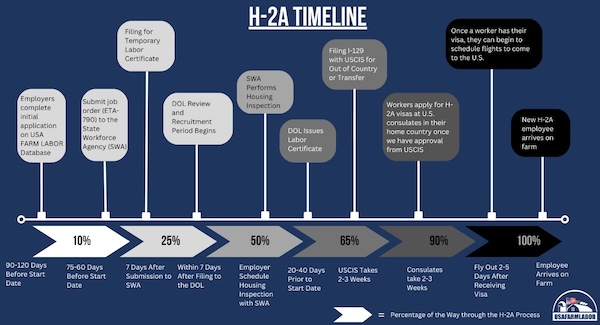
interactions between employers and various federal agencies involved in H‑2A processing. The goal is to reduce duplicative paperwork, improve transparency on case status, and shorten processing times that currently force growers to plan months ahead with substantial uncertainty.
The bill also authorizes multi‑year labor certifications and housing inspections, letting employers avoid repeating the entire certification process from scratch every year when using the same workers and housing arrangements. For farmer cooperatives specifically, SAWA clarifies that co‑ops can participate in H‑2A on behalf of their members, which NCFC and other co‑op advocates see as a way to centralize compliance costs and negotiation for smaller operators.
Compared with the bipartisan Farm Workforce Modernization Act, which paired H‑2A reforms with an earned legal status track, SAWA is more narrowly focused on labor access and employer cost certainty, leaving broader immigration regularization off the table. The bill likely faces pushback from worker‑rights groups and immigration hawks: the former over the lack of permanent status and wage caps, the latter over waivers that let some undocumented workers transition into H‑2A. Whether it can gain enough bipartisan support in this divided Congress remains to be seen. (Sources: Agnavigator, Oklahoma Farm Report, US House, American Farm Bureau)