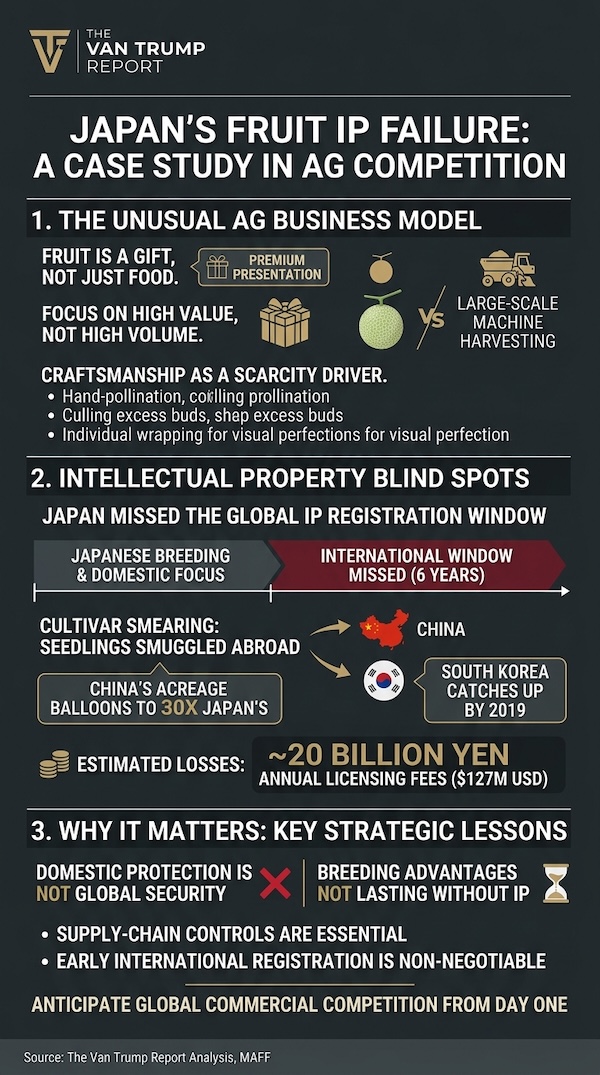



Japan’s premium-fruit business rests on an unusual proposition: fruit is not just food. At the highest end of the market, it is a gift, a regional calling card, a showcase for agricultural skill, and a product judged as much by appearance and presentation as by flavor. That model has helped Japanese growers earn high returns from limited land. But an aging farm population and foreign competitors growing Japanese-developed varieties at lower cost are now putting it under pressure. Sound familiar… somewhat similar to what has happened globally, with US technology and teachings helping other nations grow a bigger crop, and those nations are now beating us in the global export market as they can produce many crops and food varieties cheaper.
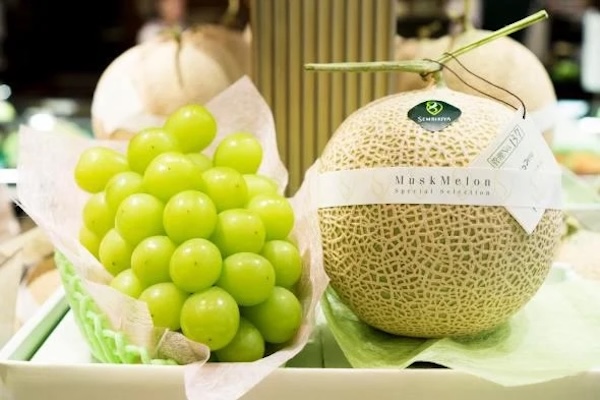
As odd as it sounds, Japan is famous for growing fruit that looks almost too perfect to eat. Individually protected melons, grapes the size of ping-pong balls, and the reddest strawberries are packed in fancy presentation boxes. The products can be wildly expensive because they are grown through a labor-intensive system designed to produce a small share of visually flawless fruit. Costs range from $10 to $100+ for mid-tier luxury items to $150 to $300+ for high-end boutique varieties. Ultra-rare specimens sold at prestige auctions can even reach thousands of dollars.
The highest-grade fruit is typically cultivated with practices that would be uneconomic in most commodity-oriented fruit systems. Growers may hand-pollinate flowers, remove excess buds and fruit, manage light exposure, rotate individual fruit for even color, wrap fruit in protective bags, and reject specimens with small visual defects. Premium melon production can involve keeping just one fruit per stem so the plant’s resources are concentrated on a single, exceptional melon.
The luxury-fruit model developed in part because Japan’s agricultural geography makes high-volume, low-cost production difficult. The country has limited flat farmland, and many orchards are small, fragmented, and located in hilly or mountainous regions. Those conditions discourage the sort of large-scale mechanized production common in major fruit-exporting countries.
Japanese growers therefore had a practical incentive to focus on value rather than volume. A small orchard cannot easily compete with a vast low-cost operation in Chile, China, or the United States. It can, however, compete by earning more from every square meter of land and every piece of fruit. Small production runs can be marketed as scarce. Skilled labor can be marketed as craftsmanship. A local variety can become a regional brand.
Economics alone would not have created a market for very costly fruit. Japan’s social customs gave the system a durable source of demand. In Japan, gift-giving is crucial for maintaining social and professional relationships. Trade protection and strict import rules historically also helped sustain higher domestic farm prices. The result was an agricultural sector that had more room to prioritize quality, regional identity, and price stability instead of competing solely on cost.
That unique and carefully crafted system is increasingly under threat, however, as international competitors seek to copy its success. Shine Muscat grapes offer the clearest example. Japan spent over three decades developing the premium, crisp-skinned Shine Muscat grape, but failed to register the cultivar’s intellectual property overseas within the international 6-year window. Seedlings were smuggled to China and South Korea, where large-scale cultivation ballooned.
Today, Chinese Shine Muscat acreage is roughly 30 times larger than Japan’s, flooding regional markets with far cheaper alternatives. South Korean acreage had caught up with Japan’s by 2019. Japan’s Ministry of Agriculture, Forestry and Fisheries estimated lost licensing fees connected to the variety at around 20 billion yen (roughly USD$127 million) annually. But because Japan missed the foreign registration window, foreign growers were not breaking international law when they cultivated and propagated the vines locally.
Japan assumed that strong domestic laws (Plant Variety Protection Act) were sufficient to safeguard its crops. However, that domestic focus created a blind spot – breeders focused on protecting local farmers rather than anticipating global commercial competition. Unlicensed foreign producers not only captured their own domestic markets, but also began exporting cheap “Shine Muscat” grapes to third-party countries, directly undercutting legitimate, expensive Japanese exports.
Japan has radically overhauled plant-variety protections and sought to limit the unauthorized export of seedlings and cuttings. Still, the Shine Muscat case shows that a breeding breakthrough is not automatically a lasting competitive advantage. Intellectual property must be protected early, in every major target market, and backed by enforceable supply-chain controls. (Sources: Slate, Agfunder News, Food Navigator, Bloomberg, USDA)