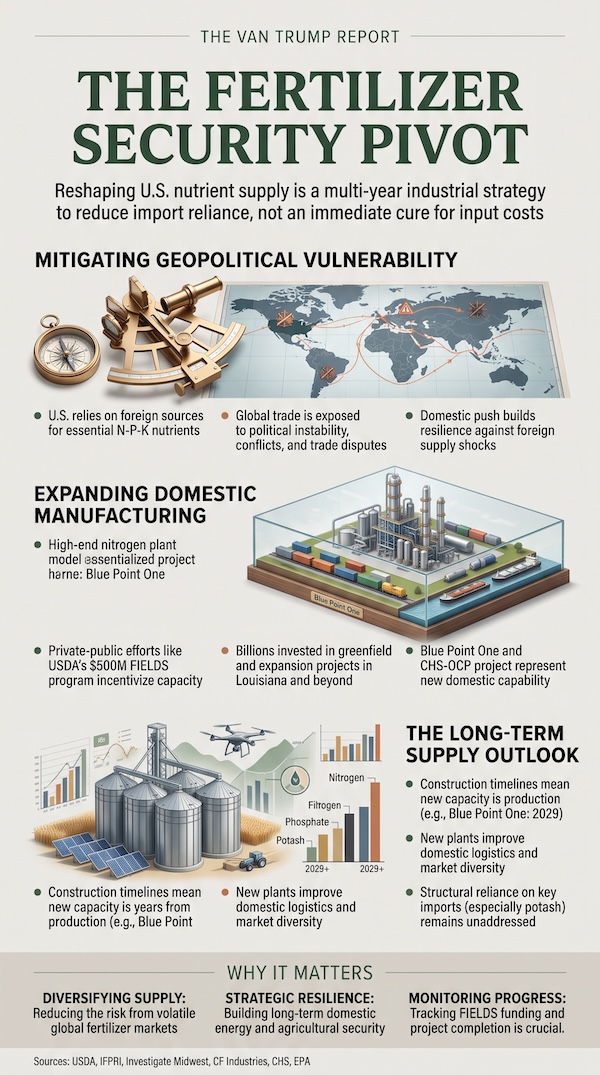



The United States is mounting a new push to expand domestic fertilizer manufacturing, driven by high farm-input costs, vulnerable international supply chains, and heavy reliance on imports for key crop nutrients. The effort combines large private-sector projects in Louisiana with a new $500 million USDA financing program, faster permitting initiatives, and temporary trade relief intended to bridge the gap until new capacity is built.
The central reality is that fertilizer security varies sharply by nutrient. The US remains a major nitrogen producer because it has abundant natural gas, the principal feedstock for ammonia. But imports still play an important role in nitrogen supply. The country is especially dependent on foreign potash and imports a meaningful share of phosphate products and raw materials. Between April 2025 and March 2026, the United States imported roughly 8.7 million tons of potash, about 6.1 million tons of nitrogen fertilizer, and nearly 850,000 tons of phosphorus fertilizer, according to USDA data. Canada supplied nearly nine out of every 10 tons of imported potash; Russia and Canada together provided more than half of nitrogen imports; and Saudi Arabia and Mexico accounted for nearly half of phosphorus imports.
Fertilizer is one of the highest variable costs for row-crop farms, and it is exposed to forces far beyond the farm gate. Natural-gas prices influence nitrogen economics. Mine production and processing capacity influence phosphate and potash availability. Ocean freight, rail capacity, port access, sanctions, tariffs, wars, and disruptions in major exporting regions can all rapidly affect U.S. prices.
That exposure has become more evident as global fertilizer trade has faced renewed geopolitical strain. The Persian Gulf has historically been a crucial production and export region: from 2023 through 2025, the region supplied 29% of globally traded ammonia, while it accounted for 26% of DAP and 13% of MAP exports. The United States is among the significant fertilizer importers affected when those trade routes or export systems are disrupted.
Washington’s response has two tracks. First, it seeks quicker, near-term relief through policy actions that increase supply. In June, the Trump administration temporarily suspended countervailing duties on certain phosphate fertilizer imports. USDA estimated the action could reduce phosphate fertilizer prices by about -22% and save U.S. farmers approximately $1.82 billion annually if additional supplies reach the market. Those are administrative estimates rather than guaranteed farm-level outcomes, but the policy illustrates the immediate dependence on imports even as policymakers call for more domestic production.
Second, federal policy is focused on longer-term domestic manufacturing. USDA’s Fertilizer Investment & Expansion for Long-Term Domestic Supply program, known as FIELDS, makes $500 million available for projects that expand or bring online independent domestic production of nitrogen, phosphate, potash, sulfur, and other crop nutrients. It can support greenfield plants, expansions at existing facilities, and storage or distribution infrastructure that helps products reach agricultural markets.
The most concrete new nitrogen project is Blue Point One, a $3.7 billion low-carbon ammonia plant now under construction in Modeste, Louisiana. CF Industries, JERA, and Mitsui broke ground on August 26. The facility is designed for average annual ammonia production of 1.4 million metric tons and is expected to begin operations in 2029.
Ammonia is the foundation of the nitrogen fertilizer chain. It can be applied directly as anhydrous ammonia, but it is also the feedstock for products including urea and UAN. The Blue Point One project therefore adds substantial upstream nitrogen capacity, although its ultimate effect on the domestic farm-fertilizer market will depend on how much production moves into agricultural channels rather than energy or industrial markets.
Blue Point One is explicitly designed to serve both agriculture and emerging energy applications. The project uses autothermal reforming to produce hydrogen for ammonia synthesis and is designed to capture and permanently sequester 98% of carbon dioxide generated in production, according to CF Industries. The project partners are also investing in a larger industrial complex: CF plans another $550 million in scalable common infrastructure, and Linde plans to invest more than $400 million in an on-site air-separation unit.
The plant will not solve near-term fertilizer tightness. Its four-year construction cycle means its first production is not expected until 2029. Still, it represents a meaningful addition to a U.S. nitrogen system where the main constraint is not access to gas alone, but the time, capital, infrastructure, permitting, and engineering needed to turn gas into fertilizer-grade ammonia and downstream products.
A potentially more consequential project for phosphate is the proposed CHS–OCP North America production facility at Cornerstone Energy Park in Waggaman, Louisiana. The farmer-owned cooperative CHS and OCP North America announced the planned joint venture in late August. The facility is expected to produce more than 1 million metric tonnes of phosphate-based fertilizer annually and would be the first new U.S. phosphate fertilizer plant built since 1984.
The project has an estimated investment of up to $450 million. OCP Group would supply phosphoric acid, while CHS and OCP North America would distribute finished fertilizer products through their existing networks. Its Mississippi River location is intended to provide access to raw materials and barge transportation into major agricultural markets.
If completed, the Waggaman project could materially reshape the U.S. phosphate balance. CHS says domestic phosphate reserves are declining and that the United States currently imports about 40% of the phosphate-based fertilizer used to meet farm demand. The companies estimate that the new capacity could reduce U.S. dependence on imported phosphate-based fertilizer by more than 48%.
That should be interpreted carefully. The facility would still rely on imported phosphoric acid supplied by OCP Group, the Morocco-based phosphate producer. In other words, the project would increase U.S. manufacturing and finishing capacity, reduce imports of certain finished phosphate fertilizers, improve logistics flexibility, and potentially add price competition. But it would not make the United States fully independent of foreign phosphate resources or upstream feedstocks.
Blue Point One offers a similar lesson for nitrogen. Its 1.4 million-ton annual ammonia capacity should deepen domestic supply and could displace some imported ammonia or nitrogen fertilizer products over time. Yet CF has also positioned the facility as a low-carbon ammonia platform for energy markets and exports. The project may strengthen fertilizer supply resilience, but its full effect on farm-level availability and prices will depend on product allocation, downstream conversion capacity, domestic demand, export demand, and global ammonia arbitrage.
The largest import vulnerability—potash—remains largely unaddressed by these Louisiana projects. Potash is a mineral resource concentrated in a small number of producing countries, especially Canada. More domestic ammonia or phosphate processing will not eliminate the United States’ structural reliance on imported potassium fertilizer.
New fertilizer facilities face a difficult regulatory path. To help ease the burden, the Trump administration has initiated wide-ranging regulatory rollbacks and administrative permitting reforms. These moves explicitly aim to accelerate domestic manufacturing. But in the real world, there is still a ton of red-tape to overcome. For example, Blue Point One was issued both state and federal permits for civil construction activities in July, allowing construction to begin in August. But the Louisiana Department of Environmental Quality’s air permit is now being challenged in court by groups alleging the permit violated the Clean Air Act and state regulatory requirements.
The proposed CHS–OCP project faces an earlier-stage version of the same process. Detailed engineering is underway, but construction remains subject to project-related and funding approvals. CHS and OCP have applied for potential FIELDS funding, and the company says construction could take up to 24 months after approvals are secured.
Bottom line, the U.S. domestic fertilizer push is real, but it is a multi-year industrial strategy rather than an immediate cure for elevated input costs. For farmers, the likely benefits are greater supply diversity, stronger domestic logistics, and less vulnerability to disruptions in imported fertilizer markets. But domestic plants will not fully insulate U.S. prices from natural gas markets, international phosphate feedstocks, export demand, freight costs, or continued dependence on imported potash. The most important marker to watch next is whether FIELDS funding helps move additional projects from announcement to final investment decision and actual construction. (Sources: USDA, IFPRI, Investigate Midwest, CFIndustries, CHS, EPA)