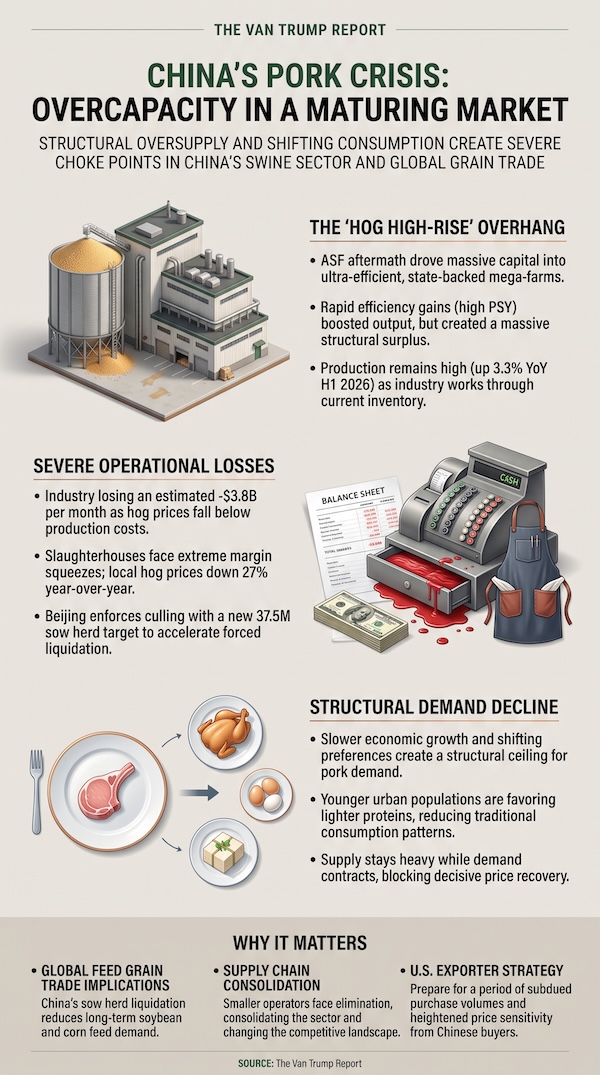



China’s hog industry is in a difficult cyclical trough: pork supply remains heavy even as farm-level capacity is being cut, while weak consumer demand has prevented prices from recovering decisively. According to reports, the industry is losing an estimated -$3.8 billion per month, with hog prices dropping below local production costs and slaughterhouses facing severe operational margin squeezes.
China is the world’s largest pork producer and consumer, and pork remains a major driver of its animal-feed demand. That makes the health of the hog sector a closely watched variable for global grain traders, especially US soybean and meal exporters.
To understand today’s crisis, we have to look back at the aftermath of China’s 2018–2019 African Swine Fever (ASF) outbreak, which wiped out nearly two-thirds of China’s pig population. In response, massive capital flooded into the sector. Backed by cheap credit and state encouragement, industrial giants built high-tech, multi-story “pig high-rises” and mega-farms. Coupled with rapid genetic improvements, efficiency surged, yielding significantly higher pigs-per-sow-per-year (PSY) metrics.
China produces roughly 700 million pigs annually. However, consumer demand hasn’t kept pace. Slower macroeconomic growth, combined with shifting dietary preferences among younger urban demographics who are favoring lighter proteins like poultry, eggs, and tofu, has created a structural demand ceiling. Simply put, China built a massive machine to produce pork just as its population decided to eat less of it. The industry’s central challenge is that production has remained high even as profitability has deteriorated. Pork production rose +3.3% year over year in the first half of 2026, while hog slaughter increased +1.7% to 372.46 million head. At the same time, pig prices have fallen sharply as supply has outpaced demand. Average live-hog prices in the first 6-months of the year were down -27% from a year earlier. Wholesale pork prices were also down, at roughly -28% below year-ago levels.
The immediate effect is not necessarily a sharp drop in soybean imports. China’s current hog production remains high, and pork output actually increased during the first half of 2026. Even if breeders reduce sow numbers today, market hogs already in the production pipeline will continue reaching slaughter for months. Feed demand may therefore remain substantial in the near term, especially if producers continue raising hogs to market weight and the poultry sector remains strong.
Notably, Beijing has lowered its national target for the breeding sow herd to 37.5 million head to encourage liquidation, prompting big hog producers to cut back on breeding sows and cancel new projects. As Chinese slaughterhouses continue to consolidate, U.S. producers and exporters may need to prepare for a period of subdued purchase volumes and heightened price sensitivity from Chinese buyers.
China is also actively seeking to reduce its dependence on soybean meal in livestock rations. Policymakers and industry groups have promoted lower-protein feeds, more efficient amino-acid balancing and greater use of alternative protein ingredients. These strategies can reduce soybean-meal inclusion rates per animal even if total livestock output remains relatively stable.
The effect on soybean trade largely depends on scale. A modest reduction in hog numbers could be offset by stronger poultry production, higher vegetable-oil demand, or larger imports for strategic and commercial inventories. But a prolonged hog-sector contraction would make China’s soybean-import growth less dependable, particularly during periods when supplies from Brazil are competitively priced. (Sources: Reuters, DimSums, AHDB, The Pig Site)