


Rye has long lived in the shadow of bigger US grains. Once a practical staple for farmers working with cold weather and poor soils, rye gradually lost ground to wheat and corn as US agriculture industrialized and consumer tastes shifted. Now, after decades as a niche crop, rye fans are hoping the grain can find fresh relevance not because it can outproduce wheat, but because it solves problems modern agriculture increasingly needs solved.
The “Rye Resurgence Project” is one of the groups leading the charge to revive rye in the US, both with growers and consumers. The initiative, led by Sarah Jones of Jones Farms Organics and Heather Dutton of Colorado’s San Luis Valley Water Conservancy District, is built around a pressing local challenge: the valley’s aquifer and river system are under strain, and agriculture needs lower-water cropping options that still support the local economy.
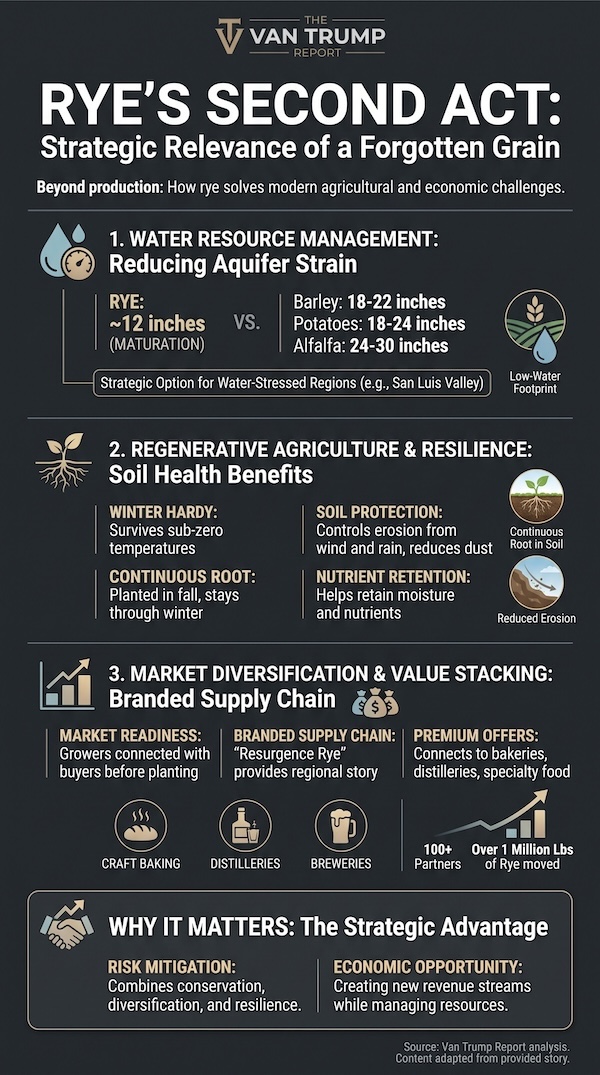
Rye fits that need unusually well. According to the project, maturing rye requires about 12 inches of water, compared with 18 to 22 inches for barley, 18 to 24 inches for potatoes, and 24 to 30 inches for alfalfa. Rye is also winter hardy, which means it can survive the San Luis Valley’s sub-zero temperatures. That means it can be planted in fall, providing a continuous root in the soil through winter.
Rye also does double duty protecting fields from soil erosion. During rain events, those roots protect the field from runoff, while also helping it to retain moisture and nutrients. Keeping a root in the soil additionally reduces dust storm conditions when conditions inevitably turn dry.
Rye Resurgence also understands that they can’t ask farmers to grow rye and just hope buyers appear. As Jones notes, “It doesn’t make sense for us to plant it if we don’t have a customer for it.” The project is building a branded supply chain around “Resurgence Rye.” That means connecting growers with bakeries, breweries, distilleries, millers, and other businesses willing to pay for a high-altitude, low-water grain with a compelling regional story.
Early results suggest the concept has legs. RRP now successfully collaborates with local craft bakeries (e.g., Moxie Bread Co.), regional distillers (e.g., Laws Whiskey House, Dryland Distillery), and specialty food companies to create products ranging from artisan shortbread ice cream to craft beers and high-end whiskeys. The Rye Resurgence Project currently counts over 100 partners that have helped organizers move around 1 million pounds of rye into new markets.
Rye Rusurgence is not alone in trying to raise awareness about rye’s potential. Groups like “Rye Revival” and the “Kentucky Cereal Rye Cover Crop Initiative” are dedicated solely to rye education and promotion, while organizations such as “Artisan Grain Collaborative” and “Colorado Grain Chain” promote small grains in general, including rye.
Rye has a long history in the US. First brought to North America by European settlers, the hardy grain thrived in the cold winters and poor, acidic sandy soils of the Atlantic coast where delicate wheat often failed. Rye’s commercial footprint reached its absolute zenith between 1910 and 1935. Driven by wartime agricultural demand during World War I, American farmers harvested between 6 and 7 million acres of rye annually.
Despite its historical dominant footprint, rye experienced one of the most drastic declines of any major crop in modern agricultural history. By the late 20th century, total U.S. food-grade production had plummeted to less than 10% of its peak era. Today, only about 15% of the US rye crop is actually harvested because most rye acres are grown as a cover crop and terminated before it reaches the heading stage.
The bigger takeaway is that a rye resurgence is less about replacing major row crops and more about stacking value. The grain offers soil benefits, water savings, rotational flexibility, and premium market potential all at once. In an era when growers are being asked to simultaneously conserve resources, diversify income, and improve resilience, this old grain from the past could play an important role in the next chapter of American agriculture. (Sources: FoodPrint, Capital Press, Rye Resurgence, RyeRevival, Food Republic, USDA)