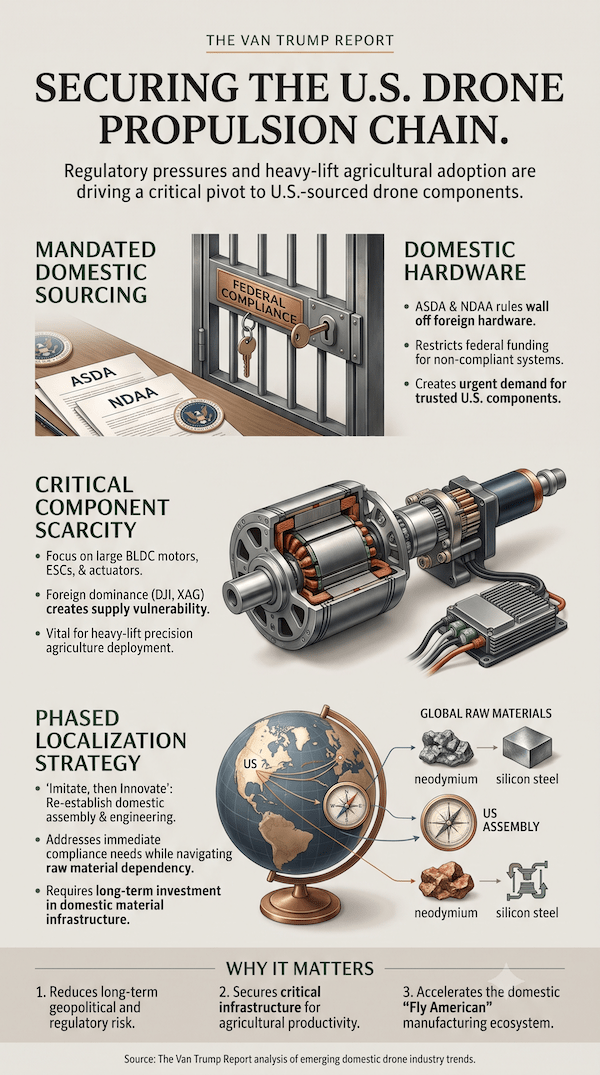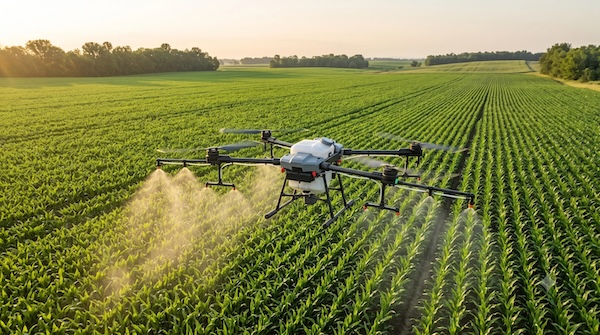



The North American commercial drone market is undergoing a structural transformation driven by supply-chain vulnerabilities, federal legislative pushes for domestic component sourcing, and the rapid adoption of heavy-lift aerial platforms in precision agriculture. Reliance on foreign-made propulsion systems, once the industry standard, has introduced mounting regulatory and operational risks. Emerging from this shift, American startup “USA Drone Motors” is carving out a vital position by promising high-reliability, domestic brushless DC (BLDC) motors designed to meet National Defense Authorization Act (NDAA) compliance standards while enduring the extreme demands of modern farming.
Regulatory Background – A wave of federal legislative and regulatory actions—headlined by the American Security Drone Act (ASDA) and expanded Federal Communications Commission (FCC) restrictions—has effectively walled off foreign-made drones from federal funding and restricted market authorization for new foreign flight hardware. While U.S. aircraft OEMs can readily design software, sensors, and carbon-fiber airframes, domestic production of flight-critical propulsion hardware—specifically high-torque BLDC motors, electronic speed controllers (ESCs), and actuators—remains scarce. This has created an urgent scramble to find non-foreign component suppliers.
Filling the Heavy-Lift Bottleneck – Founded by precision manufacturing and robotics expert Jon Facer, USA Drone Motors emerged from stealth in July 2026 to target the single biggest bottleneck in domestic UAV manufacturing: heavy-lift propulsion. The idea took shape after Facer visited component suppliers in China and attended a commercial agricultural drone conference in Kansas City. Meeting face-to-face with U.S. drone builders revealed a universal challenge: while domestic manufacturers could design software and airframes locally, virtually all heavy-lift motors, actuators, and electronic speed controllers (ESCs) were sourced from foreign brands like DJI, XAG, or EA Vision. With impending FCC blocks and tightening federal rules on foreign hardware, American builders were scrambling for non-Chinese propulsion options. Facer launched USA Drone Motors in Southern California to answer that call.
Building the Hardware and Local Ecosystem – Operating as a lean pre-seed startup—comprising Facer, an intern, and a network of specialized advisers and contractors—USA Drone Motors is concentrating on assembling large electric motors, actuators, and ESCs. Rather than remaining stuck in theoretical development, the startup imported specialized manufacturing equipment to its Southern California facility and produced initial prototype batches. These working sample units are already in the hands of drone manufacturers, dealers, and agricultural operators for field testing and real-world feedback. Beyond regulatory compliance, a central advantage the company offers is rapid prototyping. U.S. Drone engineers can collaborate directly with a domestic partner to iterate custom motor specs in days rather than waiting weeks for overseas sample shipments.
Navigating Global Supply Chain Realities – Despite its domestic assembly and engineering focus, USA Drone Motors maintains a pragmatic view of current supply chain constraints. Raw inputs like rare-earth neodymium magnets, high-grade silicon steel, and certain electronics still rely heavily on international suppliers, particularly China, due to a lack of domestic infrastructure. Facer’s strategy follows an “imitate, then innovate” philosophy: re-establish U.S. engineering, assembly, and testing capabilities first, using established foreign designs as a baseline, before progressively localizing remaining raw materials over time.
The Road Ahead – Rather than rushing to raise institutional capital right out of stealth, USA Drone Motors is taking a product-first approach. The startup plans to open a formal seed funding round only after prospective customers complete testing on sample units, validate the hardware designs, and commit to initial orders.
The challenge is that being American-made is not enough by itself in today’s world. Other U.S. firms such as Oransi, American Drone Motors, and KDE Direct are already producing motors in volume or have established factories, and they are pursuing the same “American‑made, NDAA‑friendly drone motor” path, though from slightly different angles.
Still, as U.S. regulations continue to incentivize domestic manufacturing, the niche for heavy-lift drone components is poised for substantial growth. The real race is in fully establishing the domestic supply chain, and that’s likely to be more of a marathon than a sprint. You can learn more about US Drone Motors HERE. (Sources: AgFunderNews, DroneXL, DroneIntelligence)