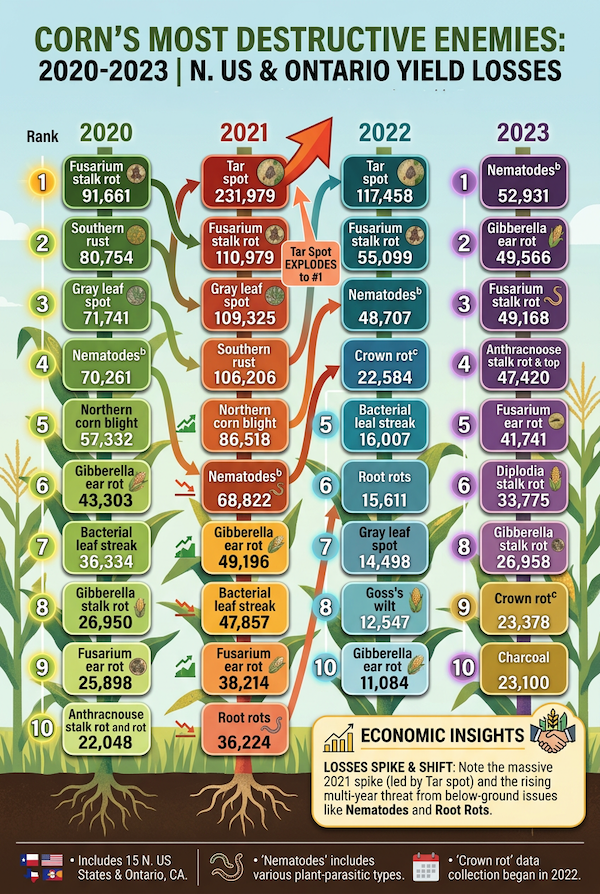



Corn diseases quietly removed about -2.5 billion bushels of grain between 2020 and 2023 across the United States and Ontario, according to a new multiyear study conducted across the US and Ontario, Canada. On average, the study finds that disease pressure costs producers an estimated $13.8 billion, even in a relatively “lighter” disease window. The full study is available HERE. Below are some of the highlights.
Scope of the Analysis – The Plant Health Progress study pools annual estimates from Extension plant pathologists in 29 U.S. states plus Ontario for the 2020–2023 seasons. Experts reported percent yield loss for 37 diseases or disease groups, and those losses were converted into bushels and dollars using USDA and Statistics Canada data. The findings included:
- Over four years, corn occupied 375.1 million acres and produced 59.6 billion bushels valued at $325.9 billion.
- Diseases cut yield by an average of -3.0%, with losses ranging from near zero in some Texas situations to -15.8% in Michigan during 2021.
- Total yield loss was about -2.5 billion bushels (63.7 million metric tons), with the largest single‑year hit in 2021.
Economically, that translates to about $3.5 billion per year in disease losses, or an average of $37.76 per acre across all surveyed regions.
Regional Patterns and Corn Belt Emphasis – The authors split the results into a northern region (including the core Corn Belt states, plus Colorado, New York, and Ontario) and a southern region. The northern region, where yield potential is highest, carries much of the volume and a large share of the disease losses.
- Corn diseases were estimated to have caused annual losses of 4.3% in 2020, 6.8% in 2021, 2.8% in 2022, and 3.0% in 2023. Annual estimated percent losses from 2020 to 2023 were much lower than the average percent loss from 2012 to 2019, which was 9.7%.
- Average percent losses and per‑acre dollar losses were higher in the northern region than in the southern states.
- Per‑acre losses in some northern states reached triple digits in high‑pressure years; Ohio, for example, was estimated at $168.63 per acre in 2021.
- Southern states showed lower average per‑acre losses (about $14.06 per acre) but still experienced consistent impacts from diseases such as gray leaf spot, southern rust, and nematodes.
These patterns matter for both farm and agri‑business planning: they show where disease risk routinely erodes margin and where investments in management are likely to pay.
Key Diseases Driving Losses – Three categories stand out, especially in the Corn Belt component of this national dataset.
- Tar spot caused an estimated -234.8 million bushels of loss in 2021 alone and ranked as the top yield‑reducing disease in the northern region in 2021 and 2022.
- Fusarium stalk rot remained a consistent problem, accounting for roughly -309.7 million bushels of loss between 2020 and 2023 and ranking among the top four yield‑reducing diseases over the past decade.
- Plant‑parasitic nematodes collectively caused about -264.1 million bushels of loss and, for the first time since 2012, were the number‑one yield‑reducing factor in the northern region in 2023.
- Gray leaf spot ranked among the top five causes of yield loss from 2012 to 2021 and was the greatest cause of yield loss from 2016 to 2018. However, gray leafspot did not even rank among the top 10 greatest causes of yield loss in 2023.
- Other diseases—northern corn leaf blight, southern rust, and ear rots—moved up and down the rankings with weather and cropping patterns.
Weather Impacts – Annual weather greatly impacts disease development. If weather conditions are conducive to disease development and the presence of a pathogen occurs alongside a susceptible host, severe losses can occur from the individual field level to entire states and across regions. However, during dry years, the overall risk of yield loss is lower than when wetter weather patterns favor disease development. Although precipitation is an important factor in disease development, several other weather-related factors, such as temperature, relative humidity, and weather events that move spores long distances, are critical determinants for disease risk in any particular location and year.
The authors additionally highlight two economic realities affecting producers:
- Current practices—resistant hybrids, scouting, and fungicide use—are already preventing additional losses beyond what is captured here.
- At the same time, prophylactic fungicide programs can cost more per acre than the disease losses they avoid in low‑pressure fields, underscoring the need for field‑by‑field, ROI‑based decisions.