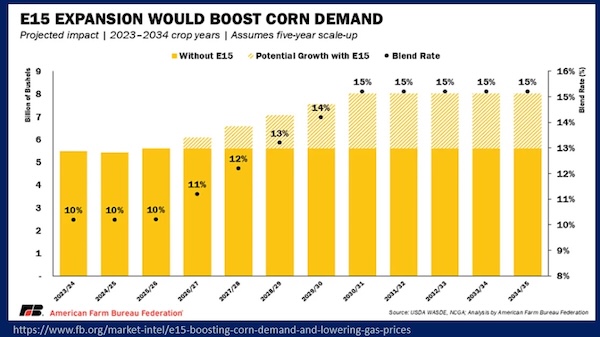



As many of you know, I am 100% all for year-round E-15 access. But there are many individuals and groups who are not, and I wanted to share the various perspectives. Still, for me, the no-brainer part of the argument is that this is NOT a mandate, but rather simply giving consumers access to E-15 year-round if they want it…
Recent analysis by the National Corn Growers Association (NCGA) reveals that expanding year-round consumer access to E15 fuel would deliver substantial economic benefits while supporting struggling corn prices and creating jobs across rural America. The study comes as legislation to ensure year-round, nationwide E15 faces significant challenges in the US Senate, as well as a conflicting University of Missouri study that is further complicating the debate.
According to NCGA’s analysis:
- Under the year-round E15+SRE Scenario, corn use for ethanol increases by approximately 0.7 billion bushels, reaching 5.8 billion bushels by the 2035/36 marketing year, compared to 5.1 billion bushels in the baseline.
- The scenario shifts RFS compliance toward greater use of ethanol (D6) RINs and fewer BBD (D4) RINs. While growth in the scenario slows relative to the baseline, BBD production still expands by more than 60% between 2025 and 2035.
- Combined ARC and PLC payments across corn and soybeans are projected to decline over the projection period. Although soybean payments increase in the initial year, those increases are more than offset by lower corn program payments.
- Net returns for corn rise by $2 to $42 per acre, averaging $22 higher than the baseline. This gain more than offsets reduced net soybean returns in every year of the projection. This translates into a net gain of more than $5 per acre, on average, for farms with an equal corn-soybean mix.
Legislation to support year-round, nationwide E15 has made some progress, with the House recently passing H.R. 1346, the “Nationwide Consumer and Fuel Retailer Choice Act,” by a vote of 218-203. The legislation would permanently extend the Reid Vapor Pressure waiver currently available for E10 gasoline to blends containing up to 15% ethanol, eliminating the Clean Air Act restrictions that currently prohibit E15 sales during summer months. President Trump and Agriculture Secretary Brooke Rollins have publicly called for Congress to pass the measure. However, passage in the Senate faces substantial challenges.
The bill requires 60 votes to pass the Senate, which is itself a substantial hurdle in the bitterly divided Congress. No Senate vote has been scheduled as of May 19, 2026, and multiple sources describe the bill’s prospects as “uncertain.” A Congressional Budget Office report showing the bill would add $2 billion to the US deficit has further dented its chances.
Another complication in moving year-round E15 forward comes from the Food and Agricultural Policy Research Institute (FAPRI) at the University of Missouri. A FAPRI study released within days of the NCGA study found that while E15 expansion alone would increase ethanol demand and boost corn prices modestly by +3 to +14 cents per bushel over the projection period, the bill pairs this expansion with automatic small refinery exemptions from Renewable Fuel Standard compliance requirements that could undermine overall agricultural benefits.
The FAPRI study concluded that E15 expansion simultaneously reduces biomass-based diesel demand, causing soybean oil prices to fall -4 to -11 cents per pound. More significantly, the bill’s small refinery exemption provisions—which would automatically exempt refineries producing less than 75,000 barrels per calendar day while only reallocating 25% of those exemptions to other obligated parties—could reduce overall RFS requirements enough that net farm income falls by as much as $1 billion below baseline during the early 2030s before partially recovering later. Under scenarios modeling 600 to 900 million gallons of small refinery exemptions, the study found these effects fall more heavily on biomass-based diesel than on ethanol, disproportionately impacting soybean oil and soybean markets.
NCGA criticized the FAPRI study as flawed, arguing it didn’t factor in historically high 2026-27 biofuel-blending requirements. However, soybean sector officials said the report confirms their concerns that automatic, permanent refinery exemptions that cannot be reallocated amount to a net loss for row crop agriculture. This division within agriculture—with corn ethanol advocates supporting the package while soybean and biodiesel interests oppose the refinery exemption structure—has intensified opposition to the bill and clouded its prospects in the Senate.
Year-round E15 availability would provide consumers with more fuel choices at the pump while expanding markets for corn growers during a challenging farm economy. The legislation positions E15 expansion as offering benefits for farmers, rural job creation, and cleaner-burning domestically produced fuel for consumers. However, the contrasting conclusions from the NCGA and FAPRI analyses highlight the complexity of evaluating H.R. 1346’s net impact, particularly given the bill’s pairing of E15 expansion with refinery exemption provisions that extend beyond fuel policy into broader Renewable Fuel Standard compliance questions. (Sources: Reuters, The Hill, IPM News, Ethanol Producer)