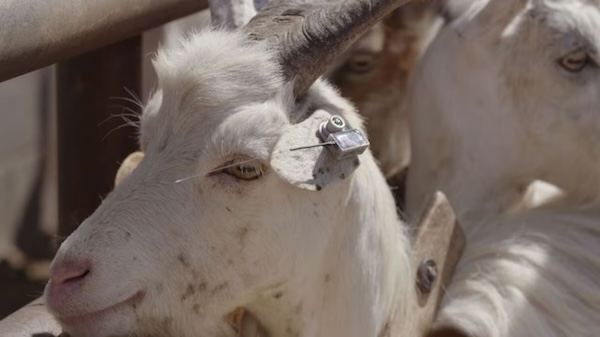



For over a decade, one of the most reliable warnings that Mount Etna in Sicily is ready to erupt have been a dozen goats outfitted with trackers. Before each of the last seven major eruptions, scientists have observed frantic behavior in the goats. When the volcano began showing signs of life earlier this year, the scientists were skeptical that there was any real danger because the goats showed no signs of distress. Turns out, the goats were right.
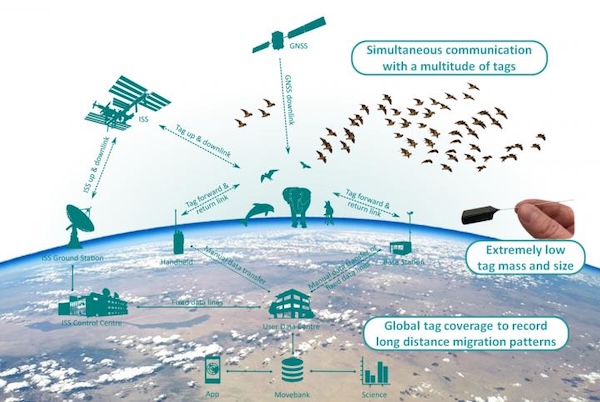
“Therefore, we still say, ‘in goats we trust,’” says Martin Wikelski, a biologist who directs the Department of Migration at the Max Planck Institute of Animal Behavior in Germany. The twelve goats are part of a global network Wikelski spent the better part of the last decade building. Known as “ICARUS” (the International Cooperation for Animal Research Using Space), the project outfits creatures in the wild with smart tags.
Dubbed the “internet of animals,” the tags have been place on everything from elephants to dragonflies. Since 2012, over 1,400 species have been entered. The tracking devices capture information about thousands of animals and their movements using GPS — and even video, sound and water temperature in some cases.
The data is beamed to satellites and collected in the Plank Institute’s “Movebank”, an open-source platform that has been monitoring over 60,000 animal species since 2007. The platform is used worldwide by a researchers, conservationists, rangers, and citizen scientists who are continually adding new data.
The network has provided a slew of valuable insights. According to Wikelski, they’ve learned that birds warn one another about dangerous obstacles such as windmills, and that elephants head to higher ground before earthquakes. Rangers using the network at Africa’s Kruger National Park discovered that vultures in Africa can double as a poacher alarm system – when one suddenly dies, a poacher is usually involved. The system allows them to detect that loss in nearly real-time, which means they can send rangers immediately.
Alerts built into the open-source analysis platform, “MoveApps,” helps Wikelski and his team monitor everything from Mount Etna’s volcanic eruptions to earthquakes and possible disease outbreaks. Wikekelski and his colleagues hope to tap into the “sixth sense” of animals to develop early warning systems.
“Animals smell better. They hear better. They see better. They have ultrasound,” says Wikelski. “All of that combined is often what we call the sixth sense of animals because we can’t really grasp it.” At Mount Etna, Wikelski and his colleagues accurately predicted major volcanic eruptions several hours in advance.
Ellen Aikens, a biologist at the University of Wyoming, believes that ICARUS will help transform the way scientists study animals. Our nonhuman neighbors “can take a pulse of the planet and be detectors of change and help us understand the health of the environment,” she said.
The original Icarus system, hosted on the International Space Station, was developed in collaboration with the Russian space agency, Roscosmos. However, all research projects with Russia were halted at the onset of the war in Ukraine, including Icarus. Now, a partnership between the Max Planck Society and German NewSpace startup Talos has launched Icarus 2.0. The 4-year partnership will give Icarus its own independently-operated and dedicated fleet of at least five CubeSats in low Earth orbit. Learn more about the ICARUS initiative HERE. (Sources: ICARUS, Science Focus, CBC, The Conversation)